Download AWS Certified Generative AI Developer - Professional.AIP-C01.ExamTopics.2026-03-26.20q.tqb
| Vendor: | Amazon |
| Exam Code: | AIP-C01 |
| Exam Name: | AWS Certified Generative AI Developer - Professional |
| Date: | Mar 26, 2026 |
| File Size: | 113 KB |
How to open TQB files?
Files with TQB (Taurus Question Bank) extension can be opened by Taurus Exam Studio.
Purchase
Coupon: TAURUSSIM_20OFF
Discount: 20%

Demo Questions
Question 1
A company is creating a workflow to review customer-facing communications before the company sends the communications. The company uses a pre-defined message template to generate the communications and stores the communications in an Amazon S3 bucket. The workflow needs to capture a specific portion from the template and send it to an Amazon Bedrock model. The workflow must store model responses back to the original S3 bucket.
Which solution will meet these requirements?
- Create a flow in Amazon Bedrock Flows. Configure S3 action nodes at the beginning and end of the flow to retrieve and store the communications and the model responses. In the middle of the flow, configure an expression to parse each communication. Configure an agent step to send the parsed input to the model for review.
- Create an AWS Step Functions Express workflow state machine. Use an Amazon S3 integration GetObject step to retrieve the original communications. Use an intrinsic function Pass step to parse the communications and to pass the results to an Amazon Bedrock InvokeModel step. Configure an Amazon S3 integration PutObject step to store the model responses back to the S3 bucket.
- Create an Amazon Bedrock agent that has an action group. Configure instructions to define how the agent should parse the communications. Configure the action group to retrieve the communications from the S3 bucket, invoke the Amazon Bedrock model, and store the model responses back to the S3 bucket.
- Create an Amazon Bedrock agent that has a single action group. Configure three AWS Lambda functions in the action group. Configure the functions to retrieve the communications from the S3 bucket, parse the communications and invoke the Amazon Bedrock model, and store the model responses back to the S3 bucket.
Correct answer: B
Question 2
A company is planning to deploy multiple generative AI (GenAI) applications to five independent business units that operate in multiple countries in Europe and the Americas. Each application uses Amazon Bedrock Retrieval Augmented Generation (RAG) patterns with business unit-specific knowledge bases that store terabytes of unstructured data.
The company must establish well-architected, standardized components for security controls, observability practices, and deployment patterns across all the GenAI applications. The components must be reusable, versioned, and governed consistently.
Which solution will meet these requirements?
- Configure Amazon API Gateway REST API endpoints for the GenAI applications. Deploy common security, observability, and RAG patterns based on the AWS Well-Architected Generative AI Lens in standardized AWS CloudFormation templates. Use CloudFormation Guard after the deployment to validate policy compliance in each business unit.
- Create standardized AWS CloudFormation templates to implement security, observability, and RAG patterns based on the AWS Well-Architected Generative AI Lens. Establish a centralized repository that performs version control. Integrate a CI/CD pipeline with CloudFormation Guard to enforce consistent and repeatable deployments across business units.
- Use AWS Service Catalog to define standardized portfolios and versioned products for each business unit. Use the portfolios to enforce security, observability, and RAG patterns based on the AWS Well-Architected Generative AI Lens. Require the business units to use the Service Catalog console to deploy resources.
- Document security controls, observability requirements, and RAG patterns based on the AWS Well-Architected Generative AI Lens in a shared design document. Use Amazon Macie to enforce deployment. Delegate implementation responsibility to each business unit.
Correct answer: C
Question 3
A GenAI developer is building a Retrieval Augmented Generation (RAG)-based customer support application that uses Amazon Bedrock foundation models (FMs). The application needs to process 50 GB of historical customer conversations that are stored in an Amazon S3 bucket as JSON files. The application must use the processed data as its retrieval corpus. The application's data processing workflow must extract relevant data from customer support documents, remove customer personally identifiable information (PII), and generate embeddings for vector storage. The processing workflow must be cost-effective and must finish within 4 hours.
Which solution will meet these requirements with the LEAST operational overhead?
- Use AWS Lambda and Amazon Comprehend to process files in parallel, remove PII, and call Amazon Bedrock APIs to generate vectors. Configure Lambda concurrency limits and memory settings to optimize throughput.
- Create an AWS Glue ETL job to run PII detection scripts on the data. Use Amazon SageMaker Processing to run the HuggingFaceProcessor to generate embeddings by using a pre-trained model. Store the embeddings in Amazon OpenSearch Service.
- Deploy an Amazon EMR cluster that runs Apache Spark with user-defined functions (UDFs) that call Amazon Comprehend to detect PII. Use Amazon Bedrock APIs to generate vectors. Store outputs in Amazon Aurora PostgreSQL with the pgvector extension.
- Implement a data processing pipeline that uses AWS Step Functions to orchestrate a workload that uses Amazon Comprehend to detect PII and Amazon Bedrock to generate embeddings. Directly integrate the workflow with Amazon OpenSearch Serverless to store vectors and provide similarity search capabilities.
Correct answer: D
Question 4
Example Corp provides a personalized video generation service that millions of enterprise customers use. Customers generate marketing videos by submitting prompts to the company's proprietary generative AI (GenAI) model. To improve output relevance and personalization, Example Corp wants to enhance the prompts by using customer-specific context such as product preferences, customer attributes, and business history.
The customers have strict data governance requirements. The customers must retain full ownership and control over their own data. The customers do not require real-time access. However, semantic accuracy must be high and retrieval latency must remain low to support customer experience use cases.
Example Corp wants to minimize architectural complexity in its integration pattern. Example Corp does not want to deploy and manage services in each customer's environment unless necessary.
Which solution will meet these requirements?
- Ensure that each customer sets up an Amazon Q Business index that includes the customer's internal data. Ensure that each customer designates Example Corp as a data accessor to allow Example Corp to retrieve relevant content by using a secure API to enrich prompts at runtime.
- Use federated search with Model Context Protocol (MCP) by deploying real-time MCP servers for each customer. Retrieve data in real time during prompt generation.
- Ensure that each customer configures an Amazon Bedrock knowledge base. Allow cross-account querying so Example Corp can retrieve structured data for prompt augmentation.
- Configure Amazon Kendra to crawl customer data sources. Share the resulting indexes across accounts so Example Corp can query each customer's Amazon Kendra index to retrieve augmentation data.
Correct answer: C
Question 5
An insurance company uses existing Amazon SageMaker AI infrastructure to support a web-based application that allows customers to predict what their insurance premiums will be. The company stores customer data that is used to train the SageMaker AI model in an Amazon S3 bucket. The dataset is growing rapidly. The company wants a solution to continuously re-train the model. The solution must automatically re-train and re-deploy the model to the application when an employee uploads a new customer data file to the S3 bucket.
Which solution will meet these requirements?
- Use AWS Glue to run an ETL job on each uploaded file. Configure the ETL job to use the AWS SDK to invoke the Sage Maker AI model endpoint. Use real-time inference with the endpoint to re-deploy the model after it is re-trained on the updated customer dataset.
- Create an AWS Lambda function and webhook handlers to generate an event when an employee uploads a new file. Configure SageMaker Pipelines to re-deploy the model after it is re-trained on the updated customer dataset. Use Amazon EventBridge to create an event bus. Set the Lambda function event as the source and SageMaker Pipelines as the target.
- Create an AWS Step Functions Express workflow with AWS SDK integrations to retrieve the customer data from the S3 bucket when an employee uploads a new file to the S3 bucket. Use a SageMaker Data Wrangler flow to export the data from the S3 bucket to SageMaker Autopilot. Use SageMaker Autopilot to re-deploy the model after it has been re-trained on the updated customer dataset.
- Create an AWS Step Functions Standard workflow. Configure the first state to call an AWS Lambda function to respond when an employee uploads a new file to the S3 bucket. Use a pipeline in SageMaker Pipelines to re-deploy the model after it has been re-trained on the updated customer dataset. Use the next state in the workflow to run the pipeline when the first state receives a response.
Correct answer: B
Question 6
A company is designing an API for a generative AI (GenAI) application that uses a foundation model (FM) that is hosted on a managed model service. The API must stream responses to reduce latency, enforce token limits to manage compute resource usage, and implement retry logic to handle model timeouts and partial responses.
Which solution will meet these requirements with the LEAST operational overhead?
- Integrate an Amazon API Gateway HTTP API with an AWS Lambda function to invoke Amazon Bedrock. Use Lambda response streaming to stream responses. Enforce token limits within the Lambda function. Implement retry logic for model timeouts by using Lambda and API Gateway timeout configurations.
- Connect an Amazon API Gateway HTTP API directly to Amazon Bedrock. Simulate streaming by using client-side polling. Enforce token limits on the frontend. Configure retry behavior by using API Gateway integration settings.
- Connect an Amazon API Gateway WebSocket API to an Amazon ECS service that hosts a containerized inference server. Stream responses by using the WebSocket protocol. Enforce token limits within Amazon ECS. Handle model timeouts by using ECS task lifecycle hooks and restart policies.
- Integrate an Amazon API Gateway REST API with an AWS Lambda function that invokes Amazon Bedrock. Use Lambda response streaming to stream responses. Enforce token limits within the Lambda function. Implement retry logic by using Lambda and API Gateway timeout configurations.
Correct answer: A
Question 7
A company deploys multiple Amazon Bedrock based generative AI (GenAI) applications across multiple business units for customer service, content generation, and document analysis. Some applications show unpredictable token consumption patterns. The company requires a comprehensive observability solution that provides real-time visibility into token usage patterns across multiple models. The observability solution must support custom dashboards for multiple stakeholder groups and provide alerting capabilities for token consumption across all the foundational models that the company's applications use.
Which combination of solutions will meet these requirements with the LEAST operational overhead? (Choose two.)
- Use Amazon CloudWatch metrics as data sources to create custom Amazon QuickSight dashboards that show token usage trends and usage patterns across FMs.
- Use Amazon CloudWatch Logs Insights to analyze Amazon Bedrock invocation logs for token consumption patterns and usage attribution by application. Create custom queries to identify high-usage scenarios. Add log widgets to dashboards to enable continuous monitoring.
- Create custom Amazon CloudWatch dashboards that combine native Amazon Bedrock token and invocation CloudWatch metrics. Set up CloudWatch alarms to monitor token usage thresholds.
- Create dashboards that show token usage trends and patterns across the company's FMs by using an Amazon Bedrock zero-ETL integration with Amazon Managed Grafana.
- Implement Amazon EventBridge rules to capture Amazon Bedrock model invocation events. Route token usage data to an Amazon Data Firehose delivery stream that targets Amazon OpenSearch Serverless. Use OpenSearch dashboards to analyze usage patterns.
Correct answer: B, C
Question 8
A company uses an organization in AWS Organizations with all features enabled to manage multiple AWS accounts. Employees use Amazon Bedrock across multiple accounts. The company must prevent specific topics and proprietary information from being included in prompts to Amazon Bedrock models. The company must ensure that employees can use only approved Amazon Bedrock models. The company centrally manages IAM roles for employees.
Which combination of solutions will meet these requirements? (Choose two.)
- Create an IAM permissions boundary for each employee's IAM role. Configure the permissions boundary to require an approved Amazon Bedrock guardrail identifier to invoke Amazon Bedrock models. Create an SCP that allows employees to use only approved models.
- Create an SCP that allows employees to use only approved models. Configure the SCP to require employees to specify a guardrail identifier in calls to invoke an approved model.
- Create an SCP that prevents an employee from invoking a model if a centrally deployed guardrail identifier is not specified in a call to the model. Create a permissions boundary on each employee's IAM role that allows each employee to invoke only approved models.
- Use AWS CloudFormation to create a custom Amazon Bedrock guardrail that has a block filtering policy. Use stack sets to deploy the guardrail to each account in the organization.
- Use AWS CloudFormation to create a custom Amazon Bedrock guardrail that has a mask filtering policy. Use stack sets to deploy the guardrail to each account in the organization.
Correct answer: B, E
Question 9
A financial services company needs to build a document analysis system that uses Amazon Bedrock to process quarterly reports. The system must analyze financial data, perform sentiment analysis, and validate compliance across batches of reports. Each batch contains 5 reports. Each report requires multiple foundation model (FM) calls. The solution must finish the analysis within 10 seconds for each batch. Current sequential processing takes 45 seconds for each batch.
Which solution will meet these requirements?
- Use AWS Lambda functions with provisioned concurrency to process each analysis type sequentially. Configure the Lambda function timeouts to 10 seconds. Configure automatic retries with exponential backoff.
- Use AWS Step Functions with a Parallel state to invoke separate AWS Lambda functions for each analysis type simultaneously. Configure Amazon Bedrock client timeouts. Use Amazon CloudWatch metrics to track execution time and model inference latency.
- Create an Amazon SQS queue to buffer analysis requests. Deploy multiple AWS Lambda functions with reserved concurrency. Configure each Lambda function to process different aspects of each report sequentially and then combine the results.
- Deploy an Amazon ECS cluster that runs containers that process each report sequentially. Use a load balancer to distribute batch workloads. Configure an auto-scaling policy based on CPU utilization to handle demand fluctuations.
Correct answer: B
Question 10
A medical company uses Amazon Bedrock to power a clinical documentation summarization system. The system produces inconsistent summaries when handling complex clinical documents. The system performed well on simple clinical documents.
The company needs a solution that diagnoses inconsistencies, compares prompt performance against established metrics, and maintains historical records of prompt versions.
Which solution will meet these requirements?
- Create multiple prompt variants by using Prompt management in Amazon Bedrock. Manually test the prompts with simple clinical documents. Deploy the highest performing version by using the Amazon Bedrock console.
- Implement version control for prompts in a code repository with a test suite that contains complex clinical documents and quantifiable evaluation metrics. Use an automated testing framework to compare prompt versions and document performance patterns.
- Deploy each new prompt version to separate Amazon Bedrock API endpoints. Split production traffic between the endpoints. Configure Amazon CloudWatch to capture response metrics and user feedback for automatic version selection.
- Create a custom prompt evaluation flow in Amazon Bedrock Flows that applies the same clinical document inputs to different prompt variants. Use Amazon Comprehend Medical to analyze and score the factual accuracy of each version.
Correct answer: B
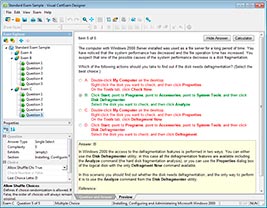
HOW TO OPEN VCE FILES
Use VCE Exam Simulator to open VCE files
HOW TO OPEN VCEX FILES
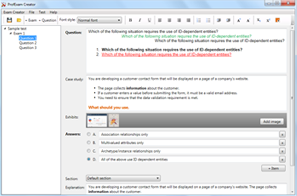
Use ProfExam Simulator to open VCEX files
ProfExam at a 20% markdown
You have the opportunity to purchase ProfExam at a 20% reduced price
Get Now!