Download AWS Certified Developer - Associate.DVA-C02.ExamTopics.2026-01-22.557q.tqb
| Vendor: | Amazon |
| Exam Code: | DVA-C02 |
| Exam Name: | AWS Certified Developer - Associate |
| Date: | Jan 22, 2026 |
| File Size: | 5 MB |
How to open TQB files?
Files with TQB (Taurus Question Bank) extension can be opened by Taurus Exam Studio.
Purchase
Coupon: TAURUSSIM_20OFF
Discount: 20%
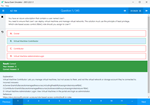
Demo Questions
Question 1
A financial company must store original customer records for 10 years for legal reasons. A complete record contains personally identifiable information (PII). According to local regulations, PII is available to only certain people in the company and must not be shared with third parties. The company needs to make the records available to third-party organizations for statistical analysis without sharing the PII.
A developer wants to store the original immutable record in Amazon S3. Depending on who accesses the S3 document, the document should be returned as is or with all the PII removed. The developer has written an AWS Lambda function to remove the PII from the document. The function is named removePii.
What should the developer do so that the company can meet the PII requirements while maintaining only one copy of the document?
- Set up an S3 event notification that invokes the removePii function when an S3 GET request is made. Call Amazon S3 by using a GET request to access the object without PII.
- Set up an S3 event notification that invokes the removePii function when an S3 PUT request is made. Call Amazon S3 by using a PUT request to access the object without PII.
- Create an S3 Object Lambda access point from the S3 console. Select the removePii function. Use S3 Access Points to access the object without PII.
- Create an S3 access point from the S3 console. Use the access point name to call the GetObjectLegalHold S3 API function. Pass in the removePii function name to access the object without PII.
Correct answer: C
Explanation:
C: 25 - Mosted C: 25 - Mosted
Question 2
A developer is deploying an AWS Lambda function The developer wants the ability to return to older versions of the function quickly and seamlessly.
How can the developer achieve this goal with the LEAST operational overhead?
- Use AWS OpsWorks to perform blue/green deployments.
- Use a function alias with different versions.
- Maintain deployment packages for older versions in Amazon S3.
- Use AWS CodePipeline for deployments and rollbacks.
Correct answer: B
Explanation:
A: 1B: 18 - Mosted A: 1B: 18 - Mosted
Question 3
For a deployment using AWS Code Deploy, what is the run order of the hooks for in-place deployments?
- BeforeInstall -> ApplicationStop -> ApplicationStart -> AfterInstall
- ApplicationStop -> BeforeInstall -> AfterInstall -> ApplicationStart
- BeforeInstall -> ApplicationStop -> ValidateService -> ApplicationStart
- ApplicationStop -> BeforeInstall -> ValidateService -> ApplicationStart
Correct answer: B
Explanation:
A: 6B: 46 - Mosted A: 6B: 46 - Mosted
Question 4
A company is implementing an application on Amazon EC2 instances. The application needs to process incoming transactions. When the application detects a transaction that is not valid, the application must send a chat message to the company's support team. To send the message, the application needs to retrieve the access token to authenticate by using the chat API.
A developer needs to implement a solution to store the access token. The access token must be encrypted at rest and in transit. The access token must also be accessible from other AWS accounts.
Which solution will meet these requirements with the LEAST management overhead?
- Use an AWS Systems Manager Parameter Store SecureString parameter that uses an AWS Key Management Service (AWS KMS) AWS managed key to store the access token. Add a resource-based policy to the parameter to allow access from other accounts. Update the IAM role of the EC2 instances with permissions to access Parameter Store. Retrieve the token from Parameter Store with the decrypt flag enabled. Use the decrypted access token to send the message to the chat.
- Encrypt the access token by using an AWS Key Management Service (AWS KMS) customer managed key. Store the access token in an Amazon DynamoDB table. Update the IAM role of the EC2 instances with permissions to access DynamoDB and AWS KMS. Retrieve the token from DynamoDDecrypt the token by using AWS KMS on the EC2 instances. Use the decrypted access token to send the message to the chat.
- Use AWS Secrets Manager with an AWS Key Management Service (AWS KMS) customer managed key to store the access token. Add a resource-based policy to the secret to allow access from other accounts. Update the IAM role of the EC2 instances with permissions to access Secrets Manager. Retrieve the token from Secrets Manager. Use the decrypted access token to send the message to the chat.
- Encrypt the access token by using an AWS Key Management Service (AWS KMS) AWS managed key. Store the access token in an Amazon S3 bucket. Add a bucket policy to the S3 bucket to allow access from other accounts. Update the IAM role of the EC2 instances with permissions to access Amazon S3 and AWS KMS. Retrieve the token from the S3 bucket. Decrypt the token by using AWS KMS on the EC2 instances. Use the decrypted access token to send the massage to the chat.
Correct answer: C
Explanation:
A: 7C: 61 - MostedD: 3 A: 7C: 61 - MostedD: 3
Question 5
A company is running Amazon EC2 instances in multiple AWS accounts. A developer needs to implement an application that collects all the lifecycle events of the EC2 instances. The application needs to store the lifecycle events in a single Amazon Simple Queue Service (Amazon SQS) queue in the company's main AWS account for further processing.
Which solution will meet these requirements?
- Configure Amazon EC2 to deliver the EC2 instance lifecycle events from all accounts to the Amazon EventBridge event bus of the main account. Add an EventBridge rule to the event bus of the main account that matches all EC2 instance lifecycle events. Add the SQS queue as a target of the rule.
- Use the resource policies of the SQS queue in the main account to give each account permissions to write to that SQS queue. Add to the Amazon EventBridge event bus of each account an EventBridge rule that matches all EC2 instance lifecycle events. Add the SQS queue in the main account as a target of the rule.
- Write an AWS Lambda function that scans through all EC2 instances in the company accounts to detect EC2 instance lifecycle changes. Configure the Lambda function to write a notification message to the SQS queue in the main account if the function detects an EC2 instance lifecycle change. Add an Amazon EventBridge scheduled rule that invokes the Lambda function every minute.
- Configure the permissions on the main account event bus to receive events from all accounts. Create an Amazon EventBridge rule in each account to send all the EC2 instance lifecycle events to the main account event bus. Add an EventBridge rule to the main account event bus that matches all EC2 instance lifecycle events. Set the SQS queue as a target for the rule.
Correct answer: D
Explanation:
A: 1B: 6C: 1D: 33 - Mosted A: 1B: 6C: 1D: 33 - Mosted
HOW TO OPEN VCE FILES
Use VCE Exam Simulator to open VCE files
HOW TO OPEN VCEX FILES
Use ProfExam Simulator to open VCEX files
ProfExam at a 20% markdown
You have the opportunity to purchase ProfExam at a 20% reduced price
Get Now!