Download AWS Certified Solutions Architect - Professional.SAP-C02.Dump4Pass.2025-09-03.446q.tqb
| Vendor: | Amazon |
| Exam Code: | SAP-C02 |
| Exam Name: | AWS Certified Solutions Architect - Professional |
| Date: | Sep 03, 2025 |
| File Size: | 3 MB |
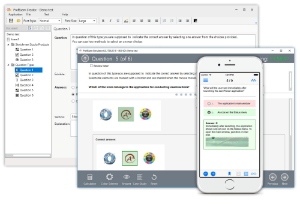
How to open TQB files?
Files with TQB (Taurus Question Bank) extension can be opened by Taurus Exam Studio.
Purchase
Coupon: TAURUSSIM_20OFF
Discount: 20%
Demo Questions
Question 1
A solutions architect needs to implement a client-side encryption mechanism for objects that will be stored in a new Amazon S3 bucket. The solutions architect created an AWS Key Management Service (AWS KMS) key for this purpose.
The solutions architect created the following IAM policy and attached it to an IAM role:
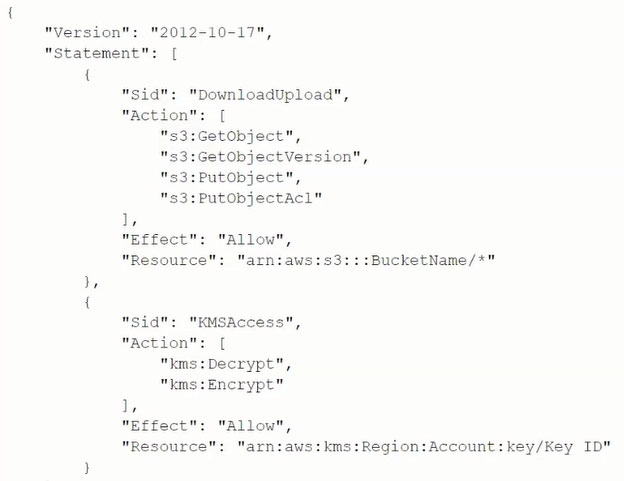
During tests, the solutions architect was able to successfully get existing test objects in the S3 bucket.
However, attempts to upload a new object resulted in an error message. The error message stated that the action was forbidden.
Which action must the solutions architect add to the IAM policy to meet all the requirements?
- kms:GenerateDataKey
- kms:GetKeyPolicy
- kms:GetPublicKey
- Activate Windows
- kms:Sign
Correct answer: A
Question 2
A company consists of two separate business units. Each business unit has its own AWS account within a single organization in AWS Organizations. The business units regularly share sensitive documents with each other. To facilitate sharing, the company created an Amazon S3 bucket in each account and configured two-way replication between the S3 buckets. The S3 buckets have millions of objects.
Recently, a security audit identified that neither S3 bucket has encryption at rest enabled. Company policy requires that all documents must be stored with encryption at rest. The company wants to implement server-side encryption with Amazon S3 managed encryption keys (SSE-S3).
What is the MOST operationally efficient solution that meets these requirements?
- Turn on SSE-S3 on both S3 buckets. Use S3 Batch Operations to copy and encrypt the objects in the same location.
- Create an AWS Key Management Service (AWS KMS) key in each account. Turn on server-side encryption with AWS KMS keys (SSE-KMS) on each S3 bucket by using the corresponding KMS key in that AWS account. Encrypt the existing objects by using an S3 copy command in the AWS CLI.
- Turn on SSE-S3 on both S3 buckets. Encrypt the existing objects by using an S3 copy command in the AWS CLI.
- Create an AWS Key Management Service (AWS KMS) key in each account. Turn on server-side encryption with AWS KMS keys (SSE-KMS) on each S3 bucket by using the corresponding KMS key in that AWS account. Use S3 Batch Operations to copy the objects into the same location.
Correct answer: A
Question 3
A retail company has an on-premises data center in Europe. The company also has a multi-Region AWS presence that includes the eu-west-1 and us-east-1 Regions. The company wants to be able to route network traffic from its on-premises infrastructure into VPCs in either of those Regions. The company also needs to support traffic that is routed directly between VPCs in those Regions. No single points of failure can exist on the network.
The company already has created two 1 Gbps AWS Direct Connect connections from its on-premises data center. Each connection goes into a separate Direct Connect location in Europe for high availability. These two locations are named DX-A and DX-B, respectively. Each Region has a single AWS Transit Gateway that is configured to route all inter-VPC traffic within that Region.
Which solution will meet these requirements?
- Create a private VIF from the DX-A connection into a Direct Connect gateway. Create a private VIF from the DX-B connection into the same Direct Connect gateway for high availability. Associate both the eu-west-1 and us-east-1 transit gateways with the Direct Connect gateway. Peer the transit gateways with each other to support cross-Region routing.
- Create a transit VIF from the DX-A connection into a Direct Connect gateway. Associate the eu-west-1 transit gateway with this Direct Connect gateway. Create a transit VIF from the DX-B connection into a separate Direct Connect gateway. Associate the us-east-1 transit gateway with this separate Direct Connect gateway. Peer the Direct Connect gateways with each other to support high availability and cross-Region routing.
- Create a transit VIF from the DX-A connection into a Direct Connect gateway. Create a transit VIF from the DX-B connection into the same Direct Connect gateway for high availability. Associate both the eu-west-1 and us-east-1 transit gateways with this Direct Connect gateway. Configure the Direct Connect gateway to route traffic between the transit gateways.
- Create rate a transit VIF from the DX-A connection into a Direct Connect gateway. Create a transit VIF from the DX-B connection into the same Direct Connect gateway for high availability. Associate both the eu-west-1 and us-east-1 transit gateways with this Direct Connect gateway. Peer the transit gateways with each other to support cross-Region routing.
Correct answer: D
Question 4
A company is running applications on AWS in a multi-account environment. The company's sales team and marketing team use separate AWS accounts in AWS Organizations.
The sales team stores petabytes of data in an Amazon S3 bucket. The marketing team uses Amazon QuickSight for data visualizations. The marketing team needs access to data that the sales team stores in the S3 bucket. The company has encrypted the S3 bucket with an AWS Key Management Service (AWS KMS) key. The marketing team has already created the IAM service role for QuickSight to provide QuickSight access in the marketing AWS account. The company needs a solution that will provide secure access to the data in the S3 bucket across AWS accounts.
Which solution will meet these requirements with the LEAST operational overhead?
- Create a new S3 bucket in the marketing account. Create an S3 replication rule in the sales account to copy the objects to the new S3 bucket in the marketing account. Update the QuickSight permissions in the marketing account to grant access to the new S3 bucket.
- Create an SCP to grant access to the S3 bucket to the marketing account. Use AWS Resource Access Manager (AWS RAM) to share the KMS key from the sales account with the marketing account. Update the QuickSight permissions in the marketing account to grant access to the S3 bucket.
- Update the S3 bucket policy in the marketing account to grant access to the QuickSight role. Create a KMS grant for the encryption key that is used in the S3 bucket. Grant decrypt access to the QuickSight role. Update the QuickSight permissions in the marketing account to grant access to the S3 bucket.
- Create an IAM role in the sales account and grant access to the S3 bucket. From the marketing account, assume the IAM role in the sales account to access the S3 bucket. Update the QuickSight role to create a trust relationship with the new IAM role in the sales account.
Correct answer: D
Question 5
A company is running a traditional web application on Amazon EC2 instances. The company needs to refactor the application as microservices that run on containers. Separate versions of the application exist in two distinct environments: production and testing. Load for the application is variable, but the minimum load and the maximum load are known. A solutions architect needs to design the updated application with a serverless architecture that minimizes operational complexity.
Which solution will meet these requirements MOST cost-effectively?
- Upload the container images to AWS Lambda as functions. Configure a concurrency limit for the associated Lambda functions to handle the expected peak load. Configure two separate Lambda integrations within Amazon API Gateway: one for production and one for testing.
- Upload the container images to Amazon Elastic Container Registry (Amazon ECR). Configure two auto scaled Amazon Elastic Container Service (Amazon ECS) clusters with the Fargate launch type to handle the expected load. Deploy tasks from the ECR images. Configure two separate Application Load Balancers to direct traffic to the ECS clusters.
- Upload the container images to Amazon Elastic Container Registry (Amazon ECR). Configure two auto scaled Amazon Elastic Kubernetes Service (Amazon EKS) clusters with the Fargate launch type to handle the expected load. Deploy tasks from the ECR images. Configure two separate Application Load Balancers to direct traffic to the EKS clusters.
- Upload the container images to AWS Elastic Beanstalk. In Elastic Beanstalk, create separate environments and deployments for production and testing. Configure two separate Application Load Balancers to direct traffic to the Elastic Beanstalk deployments.
Correct answer: B
Question 6
A financial company is planning to migrate its web application from on premises to AWS. The company uses a third-party security tool to monitor the inbound traffic to the application. The company has used the security tool for the last 15 years, and the tool has no cloud solutions available from its vendor. The company's security team is concerned about how to integrate the security tool with AWS technology.
The company plans to deploy the application migration to AWS on Amazon EC2 instances. The EC2 instances will run in an Auto Scaling group in a dedicated VPC. The company needs to use the security tool to inspect all packets that come in and out of the VPC. This inspection must occur in real time and must not affect the application's performance. A solutions architect must design a target architecture on AWS that is highly available within an AWS Region.
Which combination of steps should the solutions architect take to meet these requirements? (Select TWO.)
- Deploy the security tool on EC2 instances in a new Auto Scaling group in the existing VPC.
- Deploy the web application behind a Network Load Balancer.
- Deploy an Application Load Balancer in front of the security tool instances.
- Provision a Gateway Load Balancer for each Availability Zone to redirect the traffic to the security tool.
- Provision a transit gateway to facilitate communication between VPCs.
Correct answer: AD
Question 7
A company plans to migrate a three-tiered web application from an on-premises data center to AWS. The company developed the IJI by using server-side JavaScript libraries. The business logic and API tier uses a Python-based web framework. The data tier runs on a MySQL database.
The company custom built the application to meet business requirements. The company does not want to re-architect the application. The company needs a solution to re-platform the application to AWS with the least possible amount of development. The solution needs to be highly available and must reduce operational overhead.
Which solution will meet these requirements?
- Deploy the Ul to a static website on Amazon $3. Use Amazon CloudFront to deliver the website. Build the business logic in a Docker image. Store the image in Amazon Elastic Container Registry (Amazon ECR). Use Amazon Elastic Container Service (Amazon ECS) with the Fargate launch type to host the website with an Application Load Balancer in front. Deploy the data layer to an Amazon Aurora MySQL DB cluster.
- Build the UI and business logic in Docker images. Store the images in Amazon Elastic Container Registry (Amazon ECR). Use Amazon Elastic Container Service (Amazon ECS) with the Fargate launch type to host the Ul and business logic applications with an Application Load Balancer in front. Migrate the database to an Amazon RDS for MySQL Multi-AZ DB instance.
- Deploy the Ul to a static website on Amazon S3. Use Amazon CloudFront to deliver the website. Convert the business logic to AWS Lambda functions. Integrate the functions with Amazon API Gateway. Deploy the data layer to an Amazon Aurora MySQL DB cluster.
- Build the UI and business logic in Docker images. Store the images in Amazon Elastic Container Registry (Amazon ECR). Use Amazon Elastic Kubernetes Service (Amazon EKS) with Fargate profiles to host the Ul and business logic. Use AWS Database Migration Service (AWS DMS) to migrate the data layer to Amazon DynamoDB.
Correct answer: A
Question 8
A company has an application that runs as a Replica Set of multiple pods in an Amazon Elastic Kubernetes Service (Amazon EKS) cluster. The EKS cluster has nodes in multiple Availability Zones. The application generates many small files that must be accessible across all running instances of the application. The company needs to back up the files and retain the backups for 1 year.
Which solution will meet these requirements while providing the FASTEST storage performance?
- Create an Amazon Elastic File System (Amazon EFS) file system and a mount target for each subnet that contains nodes in the EKS cluster. Configure the ReplicaSet to mount the file system. Direct the application to store files in the file system. Configure AWS Backup to back up and retain copies of the data for 1 year.
- Create an Amazon Elastic Block Store (Amazon EBS) volume. Enable the EBS Multi-Attach feature. Configure the ReplicaSet to mount the EBS volume. Direct the application to store files in the EBS volume. Configure AWS Backup to back up and retain copies of the data for 1 year.
- Create an Amazon S3 bucket. Configure the ReplicaSet to mount the S3 bucket. Direct the application to store files in the S3 bucket. Configure S3 Versioning to retain copies of the data. Configure an S3 Lifecycle policy to delete objects after 1 year.
- Configure the ReplicaSet to use the storage available on each of the running application pods to store the files locally. Use a third-party tool to back up the EKS cluster for 1 year.
Correct answer: A
Question 9
A company has an organization that has many AWS accounts in AWS Organizations. A solutions architect must improve how the company manages common security group rules for the AWS accounts in the organization.
The company has a common set of IP CIDR ranges in an allow list in each AWS account to allow access to and from the company's on-premises network. Developers within each account are responsible for adding new IP CIDR ranges to their security groups. The security team has its own AWS account. Currently, the security team notifies the owners of the other AWS accounts when changes are made to the allow list.
The solutions architect must design a solution that distributes the common set of CIDR ranges across all accounts.
Which solution meets these requirements with the LEAST amount of operational overhead?
- Set up an Amazon Simple Notification Service (Amazon SNS) topic in the security team's AWS account. Deploy an AWS Lambda function in each AWS account. Configure the Lambda function to run every time an SNS topic receives a message. Configure the Lambda function to take an IP address as input and add it to a list of security groups in the account. Instruct the security team to distribute changes by publishing messages to its SNS topic.
- Create new customer-managed prefix lists in each AWS account within the organization. Populate the prefix lists in each account with all internal CIDR ranges. Notify the owner of each AWS account to allow the new customer-managed prefix list IDs in their accounts in their security groups. Instruct the security team to share updates with each AWS account owner.
- Create a new customer-managed prefix list in the security team's AWS account. Populate the customer-managed prefix list with all internal CIDR ranges. Share the customer-managed prefix list with the organization by using AWS Resource Access Manager. Notify the owner of each AWS account to allow the new customer-managed prefix list ID in their security groups.
- Create an IAM role in each account in the organization. Grant permissions to update security groups. Deploy an AWS Lambda function in the security team's AWS account. Configure the Lambda function to take a list of internal IP addresses as input, assume a role in each organization account, and add the list of IP addresses to the security groups in each account.
Correct answer: C
Question 10
A company wants to migrate to AWS. The company wants to use a multi-account structure with centrally managed access to all accounts and applications. The company also wants to keep the traffic on a private network. Multi-factor authentication (MFA) is required at login, and specific roles are assigned to user groups.
The company must create separate accounts for development, staging, production, and shared network.
The production account and the shared network account must have connectivity to all accounts. The development account and the staging account must have access only to each other.
Which combination of steps should a solutions architect take to meet these requirements? (Select THREE.)
- Deploy a landing zone environment by using AWS Control Tower. Enroll accounts and invite existing accounts into the resulting organization in AWS Organizations.
- Enable AWS Security Hub in all accounts to manage cross-account access. Collect findings through AWS CloudTrail to force MFA login.
- Create transit gateways and transit gateway VPC attachments in each account. Configure appropriate route tables.
- Set up and enable AWS IAM Identity Center (AWS Single Sign-On). Create appropriate permission sets with required MFA for existing accounts.
- Enable AWS Control Tower in all accounts to manage routing between accounts. Collect findings through AWS CloudTrail to force MFA login.
- Create IAM users and groups. Configure MFA for all users. Set up Amazon Cognito user pools and identity pools to manage access to accounts and between accounts.
Correct answer: ACD
HOW TO OPEN VCE FILES
Use VCE Exam Simulator to open VCE files
HOW TO OPEN VCEX FILES
Use ProfExam Simulator to open VCEX files
ProfExam at a 20% markdown
You have the opportunity to purchase ProfExam at a 20% reduced price
Get Now!