Download Implementing Cisco Service Provider Advanced Routing Solutions (SPRI).300-510.ExamTopics.2026-07-16.151q.vcex
| Vendor: | Cisco |
| Exam Code: | 300-510 |
| Exam Name: | Implementing Cisco Service Provider Advanced Routing Solutions (SPRI) |
| Date: | Jul 16, 2026 |
| File Size: | 16 MB |
How to open VCEX files?
Files with VCEX extension can be opened by ProfExam Simulator.
Purchase
Coupon: TAURUSSIM_20OFF
Discount: 20%
Demo Questions
Question 1
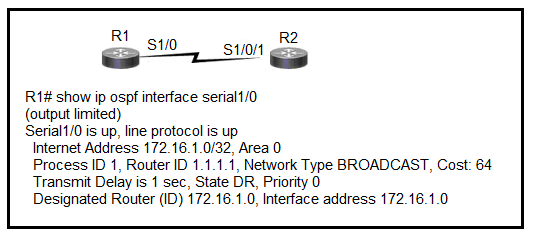
Refer to the exhibit. While configuring router 2 with all the default values, a network engineer cannot see any route received in router 1. How should the engineer solve the issue?
- Modify the IP address or mask of the interface to a valid one
- Set up a priority different than 0 in the interface
- Modify the router ID to be the interface IP on the serial
- Set the network type in S1/0 to point-to-point
Correct answer: A
Question 2
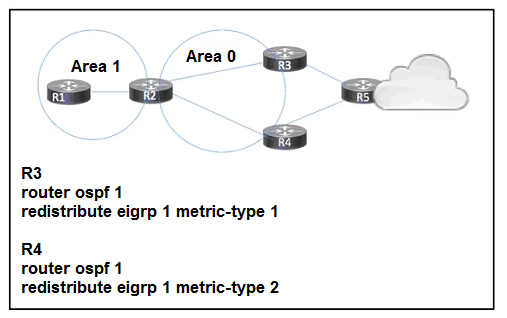
Refer to the exhibit. Routers R1, R2, R3, and R4 have been configured to run OSPF, and router R5 is running EIGRP. Traffic from R1 to R5 is expected to pass via R4, but OSPF routing has calculated the best path R3. Which action corrects the problem?
- Reconfigure R1 in Area 0
- Configure R3 to use metric-type 1 with a higher metric than R4
- Configure R1 with a static route to the R5 networks and set R5 as the next hop
- Change the metric-type value on R3 to 2
Correct answer: D
Question 3
What is a characteristic of a segment routing mapping server?
- It serves multiple VRFs.
- It applies SID mappings from one IGP instance to another IGP instance.
- It must be placed in the core of the network.
- It must have an IGP adjacency.
Correct answer: D
Question 4
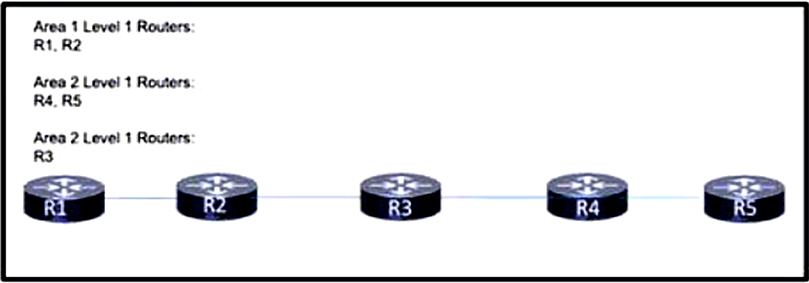
Refer to the exhibit. This network is deployed with all connected links configured to run IS-IS. The routing protocol is enabled globally on each router, and the network engineer expects full routing information to be shared among all routers. R5 is receiving routes from R4 but is missing routes from R1. Which action corrects the issue so that all routes are shared among the routers?
- Configure R5 in the same area as R1.
- Configure all routers to reside in the same area.
- Configure R1 and R5 as Level 1/Level 2 routers.
- Configure R3 as a Level 1 /Level 2 router.
Correct answer: B
Question 5
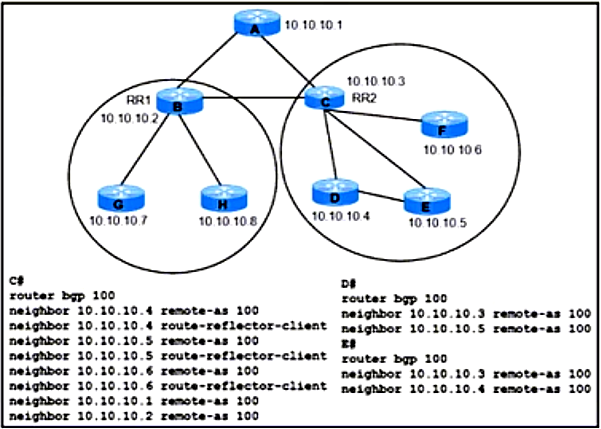
Refer to the exhibit. While troubleshooting a networking issue, an engineer identified a suboptimal communication issue on route reflector RR2. In the current environment:
• Router A is a non-route-reflector client for RR1 and RR2.
• Routers D and E are directly connected iBGP peers.
• Router F is not an iBGP peer of routers D and E.
Which action resolves the issue?
- Remove the route-reflector configuration on router RR2.
- Disable BGP client-to-client reflection on router RR2.
- Enable next-hop-self for BGP peering on router D.
- Enable next-hop-self for BGP peering on router C.
Correct answer: D
Question 6
An engineer is troubleshooting slow performance issues on a customer’s network after the last multicast configuration change was applied on it. While checking the running configuration on the router, the engineer notices there are many ip igmp join-group commands applied on several interfaces of the router which caused the high CPU utilization usage. What action must the engineer take to solve this issue?
- Configure all router interfaces to be process-switched by increasing the query interval
- Remove ip igmp join-group command on all unnecessary interfaces
- Remove unnecessary members from the IGMP group
- Configure ip igmp static-group command on all interfaces
Correct answer: D
Question 7
Which statement about enabling segment routing for IGPs is true?
- Segment routing must first be enabled under then routing process and then globally
- Segment routing must first be enabled globally and then under the routing process
- Segment routing can be enabled only under the routing process
- Segment routing can be enabled only globally
Correct answer: B
Explanation:
Reference:https://www.cisco.com/c/en/us/td/docs/ios-xml/ios/seg_routing/configuration/xe-16-6/segrt-xe-16-6-book/sr-ospfv2-node-sid.html Reference:
https://www.cisco.com/c/en/us/td/docs/ios-xml/ios/seg_routing/configuration/xe-16-6/segrt-xe-16-6-book/sr-ospfv2-node-sid.html
Question 8
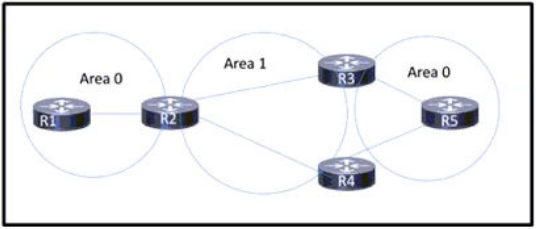
Refer to the exhibit. A network engineer just replaced five routers on this OSPF network. When the routing protocol is brought up, R5 cannot reach routes that originate on R1. The engineer verified that all connected links have established neighbor relationships. R5 reaches routes originating on R3 and R4. Which action resolves the issue?
- Configure each link to be point-to-point.
- Configure an OSPF virtual link to bridge Area 0 on routers R3 and R4.
- Configure automatic neighbor discovery on R1 and R5.
- Configure OSPF to have a contiguous Area 0.
Correct answer: D
Question 9
Refer to the exhibit.
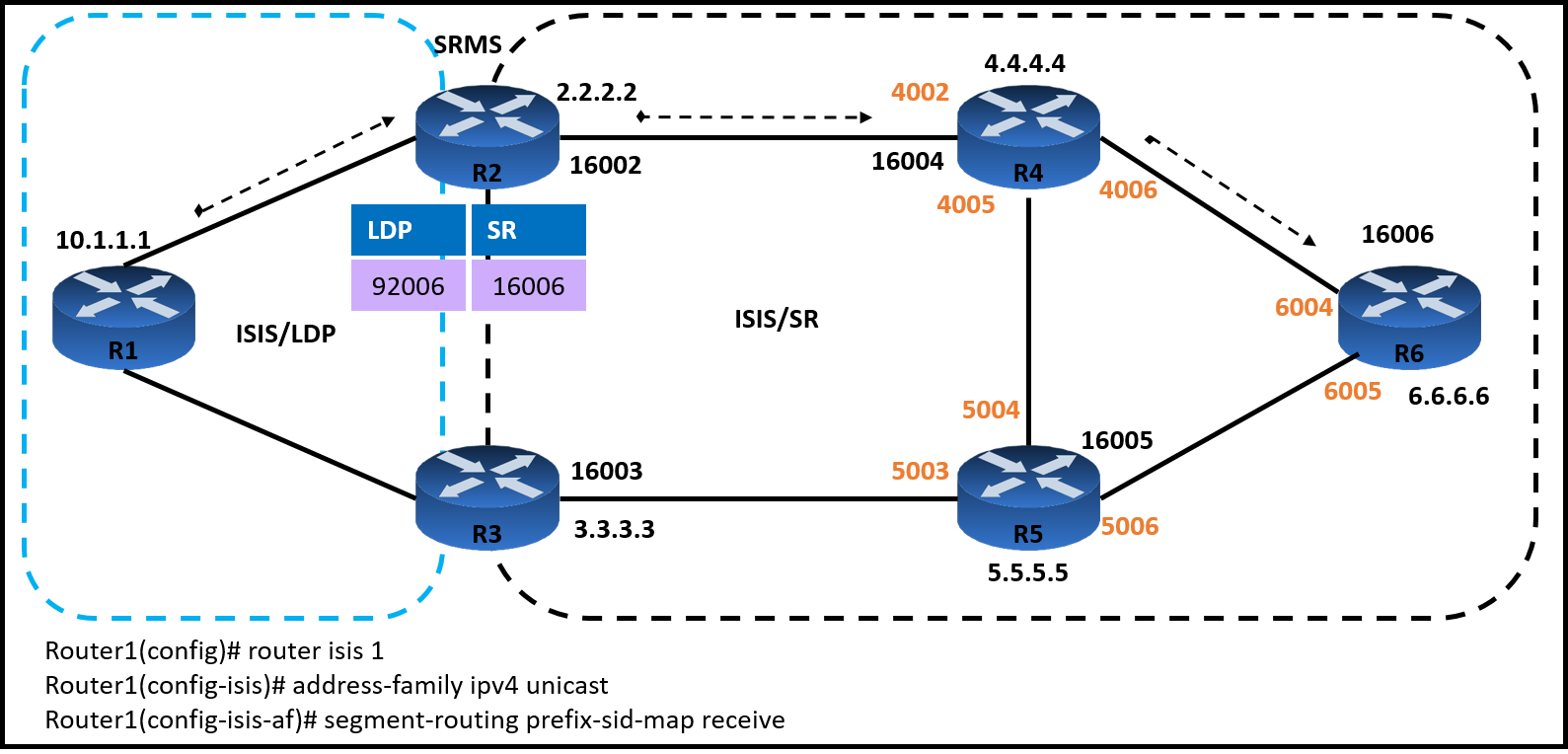
An engineer is configuring service traffic from router R1 to R6 as shown. Which additional configuration must the engineer implement so that the LDP and SR domains will participate and interwork with each other?
- Router2(config)# segment-routingRouter2(config-sr)# ldp mapping-serverRouter2(config-sr-ms)# prefix-sid-mapRouter2(config-sr-ms-map)#Router2(config-sr-ms-map-af)# 2.2.2.2/32 500 range 4
- Router2(config)# segment-routingRouter2(config-sr)# sr mapping-serverRouter2(config-sr-ms)# ldp-sid-mapRouter2(config-sr-ms-map)# address-family ipv4Router2(config-sr-ms-map-af)# 10.1.1.1/32 500 range 50
- Router2(config)# segment-routingRouter2(config-sr)# mapping-serverRouter2(config-sr-ms)# prefix-sid-mapRouter2(config-sr-ms-map)# address-family ipv4Router2(config-sr-ms-map-af)# 10.1.1.1/32 500 range 50
- Router2(config)# segment-routingRouter2(config-sr)# ldp mapping-serverRouter2(config-sr-ms)# prefix-sid-mapRouter2(config-sr-ms-map)# address-family ipv4Router2(config-sr-ms-map-af)# 2.2.2.2/32 500 range 40
Correct answer: C
Question 10
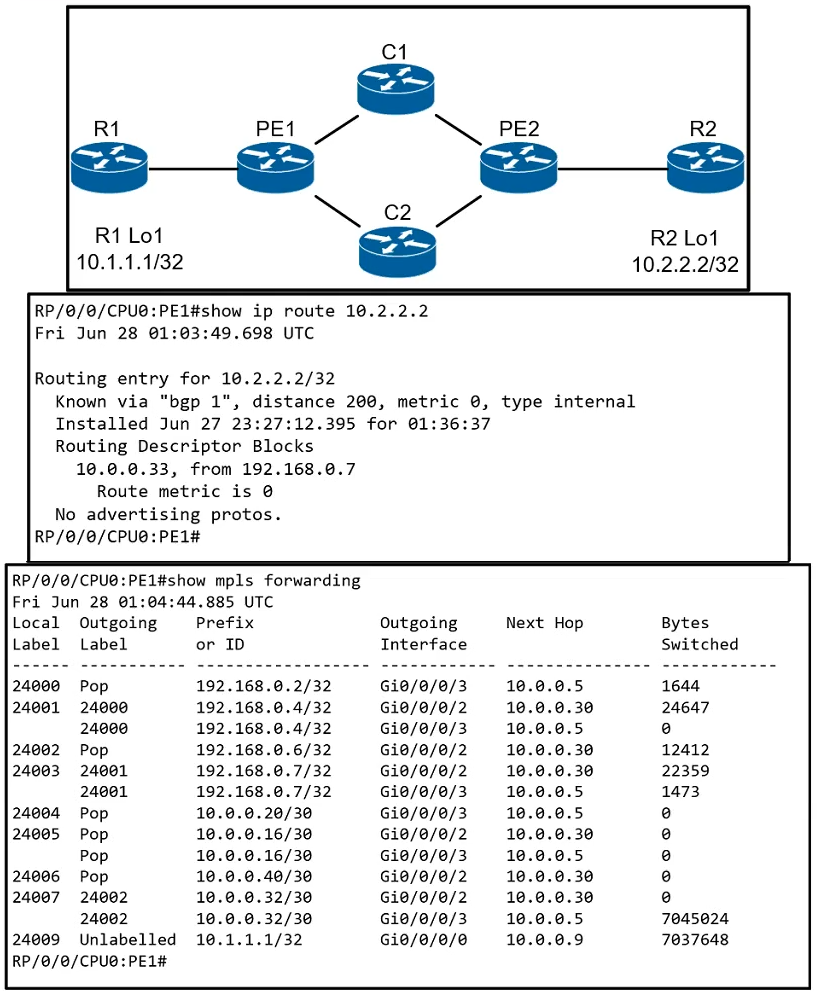
Refer to the exhibits. A network operator is troubleshooting packet loss seen from the R1 loopback interface to the R2 loopback interface over the core network. The operator is attempting to identify the next leg in the path from PE1. Which interface and label path should the operator investigate next?
- PE1 – Gi0/0/0/2 – forwarding label 24001
- PE1 – Gi0/0/0/3 – forwarding label 24002
- PE1 – Gi0/0/0/2 – forwarding label 24002
- PE1 – Gi0/0/0/3 – forwarding label 24001
Correct answer: B
Question 11
An engineer is working to implement segment routing protocol on the customer’s core network. Which step should the engineer take before the segment routing is enabled and is running with BGP?
- Segment routing must be configured with EIGRP
- Segment routing must be configured with ISIS
- MPLS must be configured
- Explicit-null must be configured for all neighbors
Correct answer: C
HOW TO OPEN VCE FILES
Use VCE Exam Simulator to open VCE files
HOW TO OPEN VCEX FILES
Use ProfExam Simulator to open VCEX files
ProfExam at a 20% markdown
You have the opportunity to purchase ProfExam at a 20% reduced price
Get Now!