Download Fortinet NSE 7 - Secure Networking 7.6 Architect.NSE7_FSN_AR-7.6.DumpsBase.2026-08-02.37q.vcex
| Vendor: | Fortinet |
| Exam Code: | NSE7_FSN_AR-7.6 |
| Exam Name: | Fortinet NSE 7 - Secure Networking 7.6 Architect |
| Date: | Aug 02, 2026 |
| File Size: | 196 KB |
How to open VCEX files?
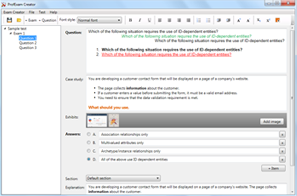
Files with VCEX extension can be opened by ProfExam Simulator.
Purchase
Coupon: TAURUSSIM_20OFF
Discount: 20%
Demo Questions
Question 1
An organization needs logical separation of routing tables, policies, and administration on one FortiGate device. Which design meets this requirement?
- VLANs with FGSP synchronization
- Split-Task or Custom VDOMs with inter-VDOM links
- Active-active FGCP with MAC overrides
- Automation Stitch with VLAN reassignment
Correct answer: B
Explanation:
VDOMs create independent logical firewall instances with separate routing tables, policies, and administrative permissions. Inter-VDOM links allow controlled communication between these virtual firewalls. VLANs alone cannot provide full administrative and routing separation VDOMs create independent logical firewall instances with separate routing tables, policies, and administrative permissions. Inter-VDOM links allow controlled communication between these virtual firewalls. VLANs alone cannot provide full administrative and routing separation
Question 2
An SD-WAN template must support FortiGate models with different WAN port names. Which FortiManager feature should be used?
- Device Blueprints with hardware port variables
- System Templates with hardware scripts
- Dynamic CLI templates at the ADOM level
- Normalized Interfaces mapping logical names to physical ports
Correct answer: D
Explanation:
Normalized Interfaces abstract hardware differences by mapping a common logical interface name to different physical interfaces on different models. This allows the same SD-WAN template to be deployed across various FortiGate platforms. The other options do not provide this abstraction. Normalized Interfaces abstract hardware differences by mapping a common logical interface name to different physical interfaces on different models. This allows the same SD-WAN template to be deployed across various FortiGate platforms. The other options do not provide this abstraction.
Question 3
Which two statements correctly describe metadata variables in FortiManager IPsec Templates?
- They can assign different local gateway IP addresses per device
- They require FortiAuthenticator validation
- They can define device-specific BGP ASNs and peer information
- They only support text fields such as descriptions
Correct answer: A, C
Explanation:
Metadata variables allow reusable templates to contain device-specific values. They can represent IP addresses, integers, and strings, making them useful for gateway addresses, BGP parameters, and other unique deployment values. The other options incorrectly limit their capabilities. Metadata variables allow reusable templates to contain device-specific values. They can represent IP addresses, integers, and strings, making them useful for gateway addresses, BGP parameters, and other unique deployment values. The other options incorrectly limit their capabilities.
Question 4
An SD-WAN member becomes dead and its associated static route disappears. Which setting causes this behavior?
- A BGP route-map drop action
- update-static-route enabled in the SD-WAN health check
- Global withdraw-dead-member configuration
- Automatic route flushing from the implicit SD-WAN rule
Correct answer: B
Explanation:
The update-static-route option allows an SD-WAN health check to remove routes associated with failed members. When the link recovers, the route can be restored automatically. The other options are unrelated or invalid FortiOS behaviors. The update-static-route option allows an SD-WAN health check to remove routes associated with failed members. When the link recovers, the route can be restored automatically. The other options are unrelated or invalid FortiOS behaviors.
Question 5
A branch uses SD-WAN DIA and must fail over SaaS traffic when latency exceeds 40 ms. Which SD-WAN feature enforces this condition?
- A static route with a higher priority metric
- A Performance SLA combined with an SD-WAN rule
- A BGP neighbor group with hold timers
- A firewall policy with traffic shaping
Correct answer: B
Explanation:
Performance SLAs monitor link conditions such as latency, jitter, and packet loss. SD-WAN rules use this information to select the best available path. Static routes and firewall traffic shaping cannot perform real-time path selection based on SLA measurements. Performance SLAs monitor link conditions such as latency, jitter, and packet loss. SD-WAN rules use this information to select the best available path. Static routes and firewall traffic shaping cannot perform real-time path selection based on SLA measurements.
Question 6
A data center uses FGSP between two standalone FortiGate devices with asymmetric routing. Which requirement is necessary for correct traffic processing?
- IPsec VPN tunnels are fully synchronized automatically by default
- Configuration changes only need to be made on the primary device
- Both devices must have matching routing tables and security policies
- A hardware heartbeat interface is required to elect cluster roles
Correct answer: C
Explanation:
FGSP synchronizes sessions between standalone FortiGate devices but does not provide automatic configuration synchronization. Both devices must have consistent routing tables, firewall policies, and inspection settings so asymmetric traffic can be processed correctly. Option A is incorrect because VPN synchronization has limitations, option B describes cluster-based configuration behavior, and option D applies to FGCP rather than FGSP. FGSP synchronizes sessions between standalone FortiGate devices but does not provide automatic configuration synchronization. Both devices must have consistent routing tables, firewall policies, and inspection settings so asymmetric traffic can be processed correctly. Option A is incorrect because VPN synchronization has limitations, option B describes cluster-based configuration behavior, and option D applies to FGCP rather than FGSP.
Question 7
A dual-hub SD-WAN Overlay Template must provide automatic recovery when a hub fails. Which technology enables this?
- BGP with BFD and hub route reflectors
- OSPFv3 demand circuits
- FGSP inside ADVPN shortcuts
- Global Performance SLA monitoring
Correct answer: A
Explanation:
The Overlay Template uses BGP-based routing with route reflectors and BFD to provide fast failure detection and dynamic path recovery. FGSP is a session synchronization technology, not a routing convergence mechanism. The Overlay Template uses BGP-based routing with route reflectors and BFD to provide fast failure detection and dynamic path recovery. FGSP is a session synchronization technology, not a routing convergence mechanism.
Question 8
A high-volume FGCP cluster experiences session synchronization bottlenecks on HA heartbeat interfaces. What optimization should be applied?
- Disable synchronization through Virtual Clustering
- Configure session-sync-dev using dedicated high-bandwidth interfaces
- Increase heartbeat loss thresholds
- Change HA traffic to standard IP routing Ethernet types
Correct answer: B
Explanation:
In large environments, session synchronization traffic can consume heartbeat interface bandwidth. Using session-sync-dev separates synchronization traffic onto dedicated interfaces while keeping heartbeat links focused on cluster monitoring. The other options do not solve synchronization bandwidth issues. In large environments, session synchronization traffic can consume heartbeat interface bandwidth. Using session-sync-dev separates synchronization traffic onto dedicated interfaces while keeping heartbeat links focused on cluster monitoring. The other options do not solve synchronization bandwidth issues.
Question 9
Branch administrators manually modify SD-WAN rules on FortiGate CLI, but changes are overwritten by FortiManager. What is the correct design approach?
- Use SD-WAN Templates with per-device mappings and managed overrides
- Disable centralized SD-WAN management
- Restore CLI changes using Automation Stitches
- Convert SD-WAN rules into local BGP route maps
Correct answer: A
Explanation:
FortiManager should remain the source of truth for managed configurations. Branch-specific exceptions should be handled through device mappings or local overrides within FortiManager instead of direct CLI modifications. The other approaches bypass centralized management. FortiManager should remain the source of truth for managed configurations. Branch-specific exceptions should be handled through device mappings or local overrides within FortiManager instead of direct CLI modifications. The other approaches bypass centralized management.
Question 10
When using the FortiManager SD-WAN Overlay Template wizard, which two components are automatically created?
- BGP neighbor configurations and route reflector settings
- FortiAnalyzer forwarding configurations for every tunnel
- OSPF virtual links across IPsec tunnels
- SD-WAN zones, IPsec members, and Performance SLAs
Correct answer: A, D
Explanation:
The SD-WAN Overlay Template automates large-scale hub-and-spoke deployments. It creates SD-WAN structures, tunnel members, SLA monitoring, and dynamic routing components such as BGP peering and route reflectors. It does not automatically create FortiAnalyzer forwarding or OSPF virtual links. The SD-WAN Overlay Template automates large-scale hub-and-spoke deployments. It creates SD-WAN structures, tunnel members, SLA monitoring, and dynamic routing components such as BGP peering and route reflectors. It does not automatically create FortiAnalyzer forwarding or OSPF virtual links.
Question 11
What is the purpose of IPsec template autorouting in FortiManager?
- Automatically create routing configurations required for IPsec tunnels
- Inject BGP routes directly without routing templates
- Monitor tunnel health and flush routes after DPD failures
- Match encryption proposals with ECMP routing
Correct answer: A
Explanation:
IPsec template autorouting reduces manual routing configuration by automatically creating required routes or routing relationships for deployed VPN tunnels. It simplifies large hub-and-spoke deployments. The other options describe unrelated routing or VPN behaviors. IPsec template autorouting reduces manual routing configuration by automatically creating required routes or routing relationships for deployed VPN tunnels. It simplifies large hub-and-spoke deployments. The other options describe unrelated routing or VPN behaviors.
HOW TO OPEN VCE FILES
Use VCE Exam Simulator to open VCE files
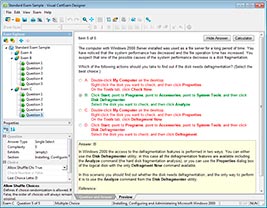
HOW TO OPEN VCEX FILES
Use ProfExam Simulator to open VCEX files
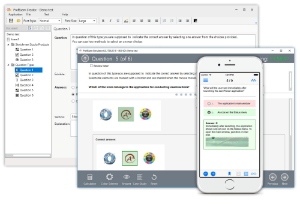
ProfExam at a 20% markdown
You have the opportunity to purchase ProfExam at a 20% reduced price
Get Now!