Download Google Professional Machine Learning Engineer.Professional-Machine-Learning-Engineer.ExamTopics.2026-01-06.339q.vcex
| Vendor: | |
| Exam Code: | Professional-Machine-Learning-Engineer |
| Exam Name: | Google Professional Machine Learning Engineer |
| Date: | Jan 06, 2026 |
| File Size: | 713 KB |
How to open VCEX files?
Files with VCEX extension can be opened by ProfExam Simulator.
Purchase
Coupon: TAURUSSIM_20OFF
Discount: 20%
Demo Questions
Question 1
You have developed an ML model to detect the sentiment of users’ posts on your company's social media page to identify outages or bugs. You are using Dataflow to provide real-time predictions on data ingested from Pub/Sub. You plan to have multiple training iterations for your model and keep the latest two versions live after every run. You want to split the traffic between the versions in an 80:20 ratio, with the newest model getting the majority of the traffic. You want to keep the pipeline as simple as possible, with minimal management required. What should you do?
- Deploy the models to a Vertex AI endpoint using the traffic-split=0=80, PREVIOUS_MODEL_ID=20 configuration.
- Wrap the models inside an App Engine application using the --splits PREVIOUS_VERSION=0.2, NEW_VERSION=0.8 configuration
- Wrap the models inside a Cloud Run container using the REVISION1=20, REVISION2=80 revision configuration.
- Implement random splitting in Dataflow using beam.Partition() with a partition function calling a Vertex AI endpoint.
Correct answer: A
Explanation:
A: 15 - Mosted A: 15 - Mosted
Question 2
You are developing a classification model to support predictions for your company’s various products. The dataset you were given for model development has class imbalance You need to minimize false positives and false negatives What evaluation metric should you use to properly train the model?
- F1 score
- Recall
- Accuracy
- Precision
Correct answer: A
Explanation:
A: 11 - Mosted A: 11 - Mosted
Question 3
You are training an object detection machine learning model on a dataset that consists of three million X-ray images, each roughly 2 GB in size. You are using Vertex AI Training to run a custom training application on a Compute Engine instance with 32-cores, 128 GB of RAM, and 1 NVIDIA P100 GPU. You notice that model training is taking a very long time. You want to decrease training time without sacrificing model performance. What should you do?
- Increase the instance memory to 512 GB, and increase the batch size.
- Replace the NVIDIA P100 GPU with a K80 GPU in the training job.
- Enable early stopping in your Vertex AI Training job.
- Use the tf.distribute.Strategy API and run a distributed training job.
Correct answer: D
Explanation:
A: 1B: 2D: 14 - Mosted A: 1B: 2D: 14 - Mosted
Question 4
You need to build classification workflows over several structured datasets currently stored in BigQuery. Because you will be performing the classification several times, you want to complete the following steps without writing code: exploratory data analysis, feature selection, model building, training, and hyperparameter tuning and serving. What should you do?
- Train a TensorFlow model on Vertex AI.
- Train a classification Vertex AutoML model.
- Run a logistic regression job on BigQuery ML.
- Use scikit-learn in Vertex AI Workbench user-managed notebooks with pandas library.
Correct answer: B
Explanation:
B: 9 - Mosted B: 9 - Mosted
Question 5
You recently developed a deep learning model. To test your new model, you trained it for a few epochs on a large dataset. You observe that the training and validation losses barely changed during the training run. You want to quickly debug your model. What should you do first?
- Verify that your model can obtain a low loss on a small subset of the dataset
- Add handcrafted features to inject your domain knowledge into the model
- Use the Vertex AI hyperparameter tuning service to identify a better learning rate
- Use hardware accelerators and train your model for more epochs
Correct answer: A
Explanation:
A: 9 - Mosted A: 9 - Mosted
Question 6
You are a data scientist at an industrial equipment manufacturing company. You are developing a regression model to estimate the power consumption in the company’s manufacturing plants based on sensor data collected from all of the plants. The sensors collect tens of millions of records every day. You need to schedule daily training runs for your model that use all the data collected up to the current date. You want your model to scale smoothly and require minimal development work. What should you do?
- Develop a custom TensorFlow regression model, and optimize it using Vertex AI Training.
- Develop a regression model using BigQuery ML.
- Develop a custom scikit-learn regression model, and optimize it using Vertex AI Training.
- Develop a custom PyTorch regression model, and optimize it using Vertex AI Training.
Correct answer: B
Explanation:
B: 14 - MostedC: 1 B: 14 - MostedC: 1
Question 7
Your organization manages an online message board. A few months ago, you discovered an increase in toxic language and bullying on the message board. You deployed an automated text classifier that flags certain comments as toxic or harmful. Now some users are reporting that benign comments referencing their religion are being misclassified as abusive. Upon further inspection, you find that your classifier's false positive rate is higher for comments that reference certain underrepresented religious groups. Your team has a limited budget and is already overextended. What should you do?
- Add synthetic training data where those phrases are used in non-toxic ways.
- Remove the model and replace it with human moderation.
- Replace your model with a different text classifier.
- Raise the threshold for comments to be considered toxic or harmful.
Correct answer: A
Explanation:
A: 15 - MostedD: 12 A: 15 - MostedD: 12
Question 8
You work for a magazine distributor and need to build a model that predicts which customers will renew their subscriptions for the upcoming year. Using your company’s historical data as your training set, you created a TensorFlow model and deployed it to Vertex AI. You need to determine which customer attribute has the most predictive power for each prediction served by the model. What should you do?
- Stream prediction results to BigQuery. Use BigQuery’s CORR(X1, X2) function to calculate the Pearson correlation coefficient between each feature and the target variable.
- Use Vertex Explainable AI. Submit each prediction request with the explain' keyword to retrieve feature attributions using the sampled Shapley method.
- Use Vertex AI Workbench user-managed notebooks to perform a Lasso regression analysis on your model, which will eliminate features that do not provide a strong signal.
- Use the What-If tool in Google Cloud to determine how your model will perform when individual features are excluded. Rank the feature importance in order of those that caused the most significant performance drop when removed from the model.
Correct answer: B
Explanation:
B: 10 - Mosted B: 10 - Mosted
Question 9
You are an ML engineer at a manufacturing company. You are creating a classification model for a predictive maintenance use case. You need to predict whether a crucial machine will fail in the next three days so that the repair crew has enough time to fix the machine before it breaks. Regular maintenance of the machine is relatively inexpensive, but a failure would be very costly. You have trained several binary classifiers to predict whether the machine will fail, where a prediction of 1 means that the ML model predicts a failure.
You are now evaluating each model on an evaluation dataset. You want to choose a model that prioritizes detection while ensuring that more than 50% of the maintenance jobs triggered by your model address an imminent machine failure. Which model should you choose?
- The model with the highest area under the receiver operating characteristic curve (AUC ROC) and precision greater than 0.5
- The model with the lowest root mean squared error (RMSE) and recall greater than 0.5.
- The model with the highest recall where precision is greater than 0.5.
- The model with the highest precision where recall is greater than 0.5.
Correct answer: C
Explanation:
C: 11 - Mosted C: 11 - Mosted
Question 10
You built a custom ML model using scikit-learn. Training time is taking longer than expected. You decide to migrate your model to Vertex AI Training, and you want to improve the model’s training time. What should you try out first?
- Train your model in a distributed mode using multiple Compute Engine VMs.
- Train your model using Vertex AI Training with CPUs.
- Migrate your model to TensorFlow, and train it using Vertex AI Training.
- Train your model using Vertex AI Training with GPUs.
Correct answer: B
Explanation:
A: 1B: 8 - MostedD: 3 A: 1B: 8 - MostedD: 3
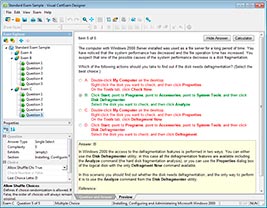
HOW TO OPEN VCE FILES
Use VCE Exam Simulator to open VCE files
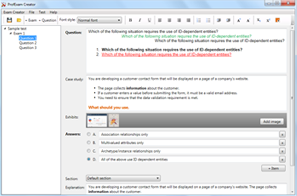
HOW TO OPEN VCEX FILES
Use ProfExam Simulator to open VCEX files
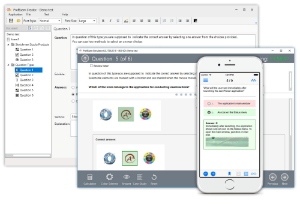
ProfExam at a 20% markdown
You have the opportunity to purchase ProfExam at a 20% reduced price
Get Now!