Download Certified Secure Software Lifecycle Professional.CSSLP.ExamTopics.2026-10-15.172q.vcex
| Vendor: | ISC2 |
| Exam Code: | CSSLP |
| Exam Name: | Certified Secure Software Lifecycle Professional |
| Date: | Oct 15, 2026 |
| File Size: | 1 MB |
How to open VCEX files?
Files with VCEX extension can be opened by ProfExam Simulator.
Purchase
Coupon: TAURUSSIM_20OFF
Discount: 20%
Demo Questions
Question 1
Which of the following is used by attackers to record everything a person types, including usernames, passwords, and account information?
- Packet sniffing
- Keystroke logging
- Spoofing
- Wiretapping
Correct answer: A, C, D
Explanation:
Keystroke logging is used by attackers to record everything a person types, including usernames, passwords, and account information. Keystroke logging is a method of logging and recording user keystrokes. It can be performed with software or hardware devices. Keystroke logging devices can record everything a person types using his keyboard, such as to measure employee's productivity on certain clerical tasks. These types of devices can also be used to come from an authentic source by forging the IP address, email address, caller ID, etc. In IP spoofing, a hacker modifies packet headers by using someone else'sIP address to hide his identity. However, spoofing cannot be used while surfing the Internet, chatting on-line, etc. because forging the source IP address causes packet sniffing is known as sniffers. There are many packet-sniffing programs that are available on the Internet. Some of these are unauthorized, which can be harmful for a network's security. Keystroke logging is used by attackers to record everything a person types, including usernames, passwords, and account information. Keystroke logging is a method of logging and recording user keystrokes. It can be performed with software or hardware devices. Keystroke logging devices can record everything a person types using his keyboard, such as to measure employee's productivity on certain clerical tasks. These types of devices can also be used to come from an authentic source by forging the IP address, email address, caller ID, etc. In IP spoofing, a hacker modifies packet headers by using someone else's
IP address to hide his identity. However, spoofing cannot be used while surfing the Internet, chatting on-line, etc. because forging the source IP address causes packet sniffing is known as sniffers. There are many packet-sniffing programs that are available on the Internet. Some of these are unauthorized, which can be harmful for a network's security.
Question 2
Which of the following methods is a means of ensuring that system changes are approved before being implemented, only the proposed and approved changes are implemented, and the implementation is complete and accurate?
- Configuration control
- Documentation control
- Configuration identification
- Configuration auditing
Correct answer: A, C, D
Explanation:
Documentation control is a method of ensuring that system changes should be agreed upon before being implemented, only the proposed and approved changes are implemented, and the implementation is complete and accurate. Documentation control is involved in the strict events for proposing, monitoring, and approving system changes and their implementation. It helps the change process by supporting the person who synchronizes the analytical task,Configuration auditing is the quality assurance element of configuration management. It is occupied in the process of periodic checks to establish the consistency and completeness of accounting information and to validate that all configuration management policies are being followed. Configuration audits are broken into functional and physical configuration audits. They occur either at delivery or at the moment of effecting the change. A functional configuration audit ensures that functional and performance attributes of a configuration item are achieved, while a physical configuration audit ensures that a configuration item is installed in management. Configuration control is a set of processes and approval stages required to change a configuration item's attributes and to re-baseline them. It supports the change of the functional and physical attributes of software at various points in time, and performs systematic control of changes to the identified configuration item is a product (hardware and/or software) that has an end-user purpose. These attributes are recorded in configuration documentation and baselined. Baselining an attribute forces formal configuration change control processes to be effected in the event that these attributes are changed. Documentation control is a method of ensuring that system changes should be agreed upon before being implemented, only the proposed and approved changes are implemented, and the implementation is complete and accurate. Documentation control is involved in the strict events for proposing, monitoring, and approving system changes and their implementation. It helps the change process by supporting the person who synchronizes the analytical task,
Configuration auditing is the quality assurance element of configuration management. It is occupied in the process of periodic checks to establish the consistency and completeness of accounting information and to validate that all configuration management policies are being followed. Configuration audits are broken into functional and physical configuration audits. They occur either at delivery or at the moment of effecting the change. A functional configuration audit ensures that functional and performance attributes of a configuration item are achieved, while a physical configuration audit ensures that a configuration item is installed in management. Configuration control is a set of processes and approval stages required to change a configuration item's attributes and to re-baseline them. It supports the change of the functional and physical attributes of software at various points in time, and performs systematic control of changes to the identified configuration item is a product (hardware and/or software) that has an end-user purpose. These attributes are recorded in configuration documentation and baselined. Baselining an attribute forces formal configuration change control processes to be effected in the event that these attributes are changed.
Question 3
You are the project manager of the CUL project in your organization. You and the project team are assessing the risk events and creating a probability and impact matrix for the identified risks. Which one of the following statements best describes the requirements for the data type used in qualitative risk analysis?
- A qualitative risk analysis encourages biased data to reveal risk tolerances.
- A qualitative risk analysis required unbiased stakeholders with biased risk tolerances.
- A qualitative risk analysis requires accurate and unbiased data if it is to be credible.
- A qualitative risk analysis requires fast and simple data to complete the analysis.
Correct answer: A, B, C, D
Question 4
Which of the following plans is designed to protect critical business processes from natural or man-made failures or disasters and the resultant loss of capital due to the unavailability of normal business processes?
- Contingency plan
- Business continuity plan
- Crisis communication plan
- Disaster recovery plan
Correct answer: A, B, C, D
Explanation:
The business continuity plan is designed to protect critical business processes from natural or man-made failures or disasters and the resultant loss of capital due to the unavailability of normal business processes. Business Continuity Planning (BCP) is the creation and validation of a practiced logistical plan for how an organization will recover and restore partially or completely interrupted critical (urgent) functions within a predetermined time after a disaster or extended exchange of information before, during, or after a crisis event. It is considered as a sub-specialty of the public relations profession that is designed to protect and defend an individual, company, or organization facing a public challenge to its reputation. The aim of crisis communication plan is to assist organizations to plan is a plan devised for a specific situation when things could go wrong. Contingency plans are often devised by governments or businesses who want to be prepared for anything that could happen. Contingency plans include specific strategies and actions to deal with specific variances to assumptions resulting in a particular problem, emergency, or state of affairs. They also include a monitoring process and "triggers" for initiating planned actions. They are required to help disaster recovery plan should contain data, hardware, and software that can be critical for a business. It should also include the plan for sudden loss such as hard disc crash. The business should use backup and data recovery utilities to limit the loss of data. The business continuity plan is designed to protect critical business processes from natural or man-made failures or disasters and the resultant loss of capital due to the unavailability of normal business processes. Business Continuity Planning (BCP) is the creation and validation of a practiced logistical plan for how an organization will recover and restore partially or completely interrupted critical (urgent) functions within a predetermined time after a disaster or extended exchange of information before, during, or after a crisis event. It is considered as a sub-specialty of the public relations profession that is designed to protect and defend an individual, company, or organization facing a public challenge to its reputation. The aim of crisis communication plan is to assist organizations to plan is a plan devised for a specific situation when things could go wrong. Contingency plans are often devised by governments or businesses who want to be prepared for anything that could happen. Contingency plans include specific strategies and actions to deal with specific variances to assumptions resulting in a particular problem, emergency, or state of affairs. They also include a monitoring process and "triggers" for initiating planned actions. They are required to help disaster recovery plan should contain data, hardware, and software that can be critical for a business. It should also include the plan for sudden loss such as hard disc crash. The business should use backup and data recovery utilities to limit the loss of data.
Question 5
At which of the following levels of robustness in DRM must the security functions be immune to widely available tools and specialized tools and resistant to professional tools?
- Level 2
- Level 4
- Level 1
- Level 3
Correct answer: C
Explanation:
At Level 1 of robustness in DRM, the security functions must be immune to widely available tools and specialized tools and resistant to professional tools. At Level 1 of robustness in DRM, the security functions must be immune to widely available tools and specialized tools and resistant to professional tools.
Question 6
The Software Configuration Management (SCM) process defines the need to trace changes, and the ability to verify that the final delivered software has all of the planned enhancements that are supposed to be included in the release. What are the procedures that must be defined for each software project to ensure that a sound SCM process is implemented? Each correct answer represents a complete solution. Choose all that apply.
- Configuration status accounting
- Configuration change control
- Configuration identification
- Configuration audits
- Configuration implementation
- Configuration deployment
Correct answer: A, B, C, D
Explanation:
The SCM process defines the need to trace changes, and the ability to verify that the final delivered software has all of the planned enhancements that are supposed to be included in the release. It identifies four procedures that must be defined for each software project to ensure that a sound SCM process is implemented. They are as follows: 1.Configuration identification: Configuration identification is the process of identifying the attributes that define every aspect of a configuration item. A configuration item is a product (hardware and/or software) that has an end-user purpose. These attributes are recorded in configuration documentation and baselined. 2.Configuration change control: Configuration change control is a set of processes and approval stages required to change a configuration item's attributes and to re-baseline them. 3.Configuration status accounting: Configuration status accounting is the ability to record and report on the configuration baselines associated with each configuration item at any moment of time. 4.Configuration audits: Configuration audits are broken into functional and physical configuration audits. They occur either at delivery or at the moment of effecting the change. A functional configuration audit ensures that functional and performance attributes of a configuration item are achieved, while a physical configuration audit ensures that a configuration item is installed in accordance with the requirements of its detailed design documentation. The SCM process defines the need to trace changes, and the ability to verify that the final delivered software has all of the planned enhancements that are supposed to be included in the release. It identifies four procedures that must be defined for each software project to ensure that a sound SCM process is implemented. They are as follows: 1.Configuration identification: Configuration identification is the process of identifying the attributes that define every aspect of a configuration item. A configuration item is a product (hardware and/or software) that has an end-user purpose. These attributes are recorded in configuration documentation and baselined. 2.Configuration change control: Configuration change control is a set of processes and approval stages required to change a configuration item's attributes and to re-baseline them. 3.Configuration status accounting: Configuration status accounting is the ability to record and report on the configuration baselines associated with each configuration item at any moment of time. 4.Configuration audits: Configuration audits are broken into functional and physical configuration audits. They occur either at delivery or at the moment of effecting the change. A functional configuration audit ensures that functional and performance attributes of a configuration item are achieved, while a physical configuration audit ensures that a configuration item is installed in accordance with the requirements of its detailed design documentation.
Question 7
In which of the following deployment models of cloud is the cloud infrastructure operated exclusively for an organization?
- Public cloud
- Community cloud
- Private cloud
- Hybrid cloud
Correct answer: C
Explanation:
In private cloud, the cloud infrastructure is operated exclusively for an organization. The private cloud infrastructure is administered by the organization or a third party, and exists on premise and off premise. In private cloud, the cloud infrastructure is operated exclusively for an organization. The private cloud infrastructure is administered by the organization or a third party, and exists on premise and off premise.
Question 8
Which of the following security controls works as the totality of protection mechanisms within a computer system, including hardware, firmware, and software, the combination of which is responsible for enforcing a security policy?
- Common data security architecture (CDSA)
- Application program interface (API)
- Trusted computing base (TCB)
- Internet Protocol Security (IPSec)
Correct answer: A, B, C, D
Explanation:
Trusted computing base (TCB) refers to hardware, software, controls, and processes that cause a computer system or network to be devoid of incorrect. Internet Protocol Security (IPSec) is a standard-based protocol that provides the highest level of VPN security. IPSec can encrypt virtually everything above the networking layer. It is used for VPN connections that use the L2TP protocol. It secures both data and password. IPSec cannot be used with Point-to- framework. It deals with the communications and data security problems in the emerging Internet and intranet application space. It presents an infrastructure for(API) is an interface implemented by a software program which enables it to interact with other software. It facilitates interaction between different software programs similar to the way the user interface facilitates interaction between humans and computers. An API is implemented by applications, libraries, and operating systems to determine their vocabularies and calling conventions, and is used to access their services. It may include specifications for routines, data structures, object classes, and protocols used to communicate between the consumer and the implementer of the API. Trusted computing base (TCB) refers to hardware, software, controls, and processes that cause a computer system or network to be devoid of incorrect. Internet Protocol Security (IPSec) is a standard-based protocol that provides the highest level of VPN security. IPSec can encrypt virtually everything above the networking layer. It is used for VPN connections that use the L2TP protocol. It secures both data and password. IPSec cannot be used with Point-to- framework. It deals with the communications and data security problems in the emerging Internet and intranet application space. It presents an infrastructure for
(API) is an interface implemented by a software program which enables it to interact with other software. It facilitates interaction between different software programs similar to the way the user interface facilitates interaction between humans and computers. An API is implemented by applications, libraries, and operating systems to determine their vocabularies and calling conventions, and is used to access their services. It may include specifications for routines, data structures, object classes, and protocols used to communicate between the consumer and the implementer of the API.
Question 9
You are responsible for network and information security at a large hospital. It is a significant concern that any change to any patient record can be easily traced back to the person who made that change. What is this called?
- Availability
- Confidentiality
- Non repudiation
- Data Protection
Correct answer: C
Explanation:
Non repudiation refers to mechanisms that prevent a party from falsely denying involvement in some data transaction. Non repudiation refers to mechanisms that prevent a party from falsely denying involvement in some data transaction.
Question 10
Which of the following is an example of penetration testing?
- Implementing NIDS on a network
- Implementing HIDS on a computer
- Simulating an actual attack on a network
- Configuring firewall to block unauthorized traffic
Correct answer: A, B, C, D
Explanation:
Penetration testing is a method of evaluating the security of a computer system or network by simulating an attack from a malicious source, known as a Black Hat Hacker, or Cracker. The process involves an active analysis of the system for any potential vulnerabilities that may result from poor or improper system configuration, known and/or unknown hardware or software flaws, or operational weaknesses in process or technical countermeasures. This analysis is carried out from the position of a potential attacker, and can involve active exploitation of security vulnerabilities. Any security issues that are found will be presented to the system owner together with an assessment of their impact and often with a proposal for mitigation or a technical solution. The intent of a penetration testing is to determine feasibility of an attack and the amount of business impact of a successful exploit, if discovered. It is a component of a full penetration testing. Penetration testing is a method of evaluating the security of a computer system or network by simulating an attack from a malicious source, known as a Black Hat Hacker, or Cracker. The process involves an active analysis of the system for any potential vulnerabilities that may result from poor or improper system configuration, known and/or unknown hardware or software flaws, or operational weaknesses in process or technical countermeasures. This analysis is carried out from the position of a potential attacker, and can involve active exploitation of security vulnerabilities. Any security issues that are found will be presented to the system owner together with an assessment of their impact and often with a proposal for mitigation or a technical solution. The intent of a penetration testing is to determine feasibility of an attack and the amount of business impact of a successful exploit, if discovered. It is a component of a full penetration testing.
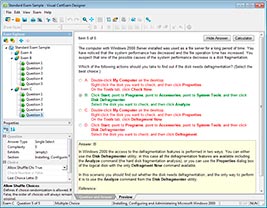
HOW TO OPEN VCE FILES
Use VCE Exam Simulator to open VCE files
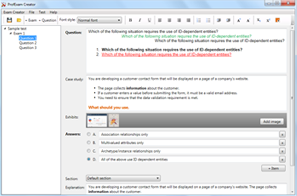
HOW TO OPEN VCEX FILES
Use ProfExam Simulator to open VCEX files
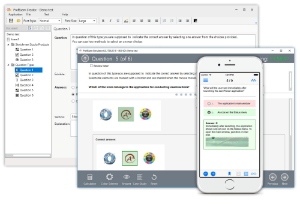
ProfExam at a 20% markdown
You have the opportunity to purchase ProfExam at a 20% reduced price
Get Now!