Download Data Center Professional.JN0-683.ExamTopics.2026-05-06.46q.vcex
| Vendor: | Juniper |
| Exam Code: | JN0-683 |
| Exam Name: | Data Center Professional |
| Date: | May 06, 2026 |
| File Size: | 4 MB |
How to open VCEX files?
Files with VCEX extension can be opened by ProfExam Simulator.
Purchase
Coupon: TAURUSSIM_20OFF
Discount: 20%
Demo Questions
Question 1
Click the Exhibit button.
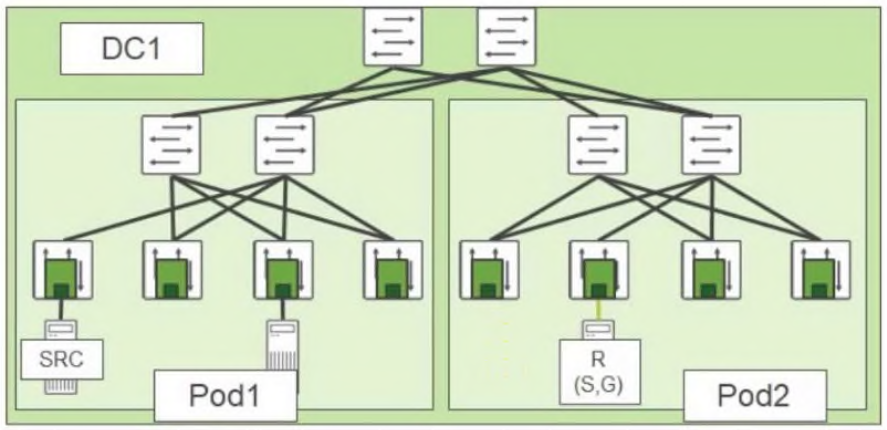
Referring to the exhibit, data center DC1 has two pods in the same broadcast domain. You want to forward multicast traffic to only one host that is interested in receiving the multicast traffic.
In this scenario, which EVPN route type would be required to accomplish this task?
- Type 6
- Type 8
- Type 7
- Type 5
Correct answer: C
Question 2
You implement a MAC-VRF routing instance with a VLAN-aware service type configured with multiple VLAN IDs.
Which statement is correct about this implementation?
- All VLANs will use the same VNI.
- All VLANs will use the same EVI.
- All VLANs will use the same bridge table.
- All VLANs will use the same broadcast domain.
Correct answer: C
Question 3
You need to deploy a new data center. As part of the switch onboarding process, you want to use Juniper Networks’ zero-touch provisioning (ZTP) process.
Which statement is correct about this scenario?
- Scripts that require execution must end with .sh or .py.
- The minimum requirement is a DHCP IP address for the ZTP process to terminate.
- The switch’s default hostname is the switch’s MAC address.
- Junos images on the devices can be upgraded, but not downgraded.
Correct answer: A
Question 4
Click the Exhibit button.
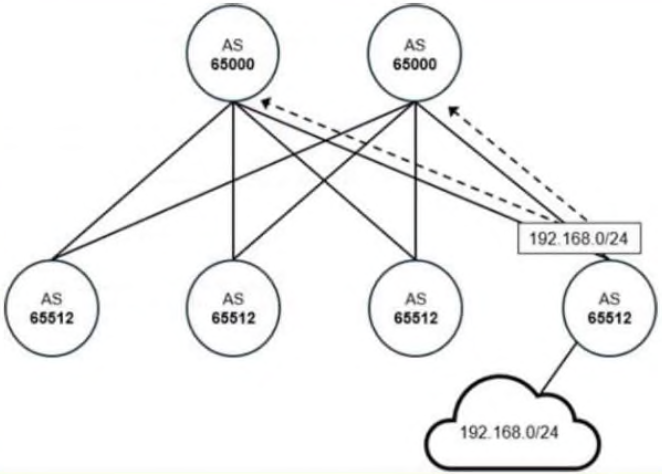
The 192.168.0.0/24 route is being advertised into your IP fabric by the leaf device in AS 65512.
In this scenario, which two statements are correct? (Choose two.)
- By default, both spine devices will accept and install the route learned from the leaf device.
- By default, each spine device will not advertise this route to all other peer leaf devices.
- By default, both spine devices will reject the route learned from the leaf device.
- By default, each spine device will advertise this route to all other peer leaf devices.
Correct answer: A, B
Question 5
Click the Exhibit button.
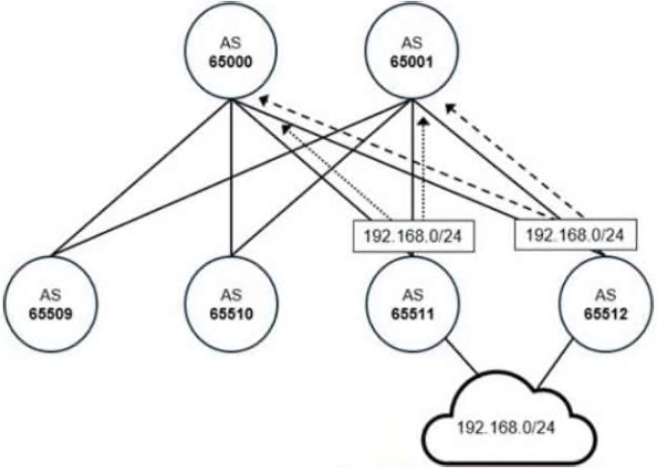
The 192.168.0.0/24 route is being advertised into your IP fabric by the leaf devices in AS 65511 and AS 65512. Both spine devices receive the routes from each of the leaf devices.
In this scenario, which two statements are correct? (Choose two.)
- By default, each spine device will advertise both route entries for this route to other leaf devices.
- By default, each spine device will only accept the first received next hop for this route from the leaf devices, while the other next hop will be rejected.
- By default, each spine device will advertise only the active route entry to the other leaf devices.
- By default, each spine device will accept both next hops for the route received from the leaf devices, but only one next hop will become the active route.
Correct answer: B, C
Question 6
You must integrate several leaf nodes that do not support the EVPN-VXLAN architecture into your existing EVPN-VXLAN-based IP fabric.
In this scenario, which two design considerations would accomplish this task? (Choose two.)
- Ethernet segment identifier
- edge-routed bridging
- generic routing encapsulation
- collapsed fabric
Correct answer: B, D
Question 7
Click the Exhibit button.
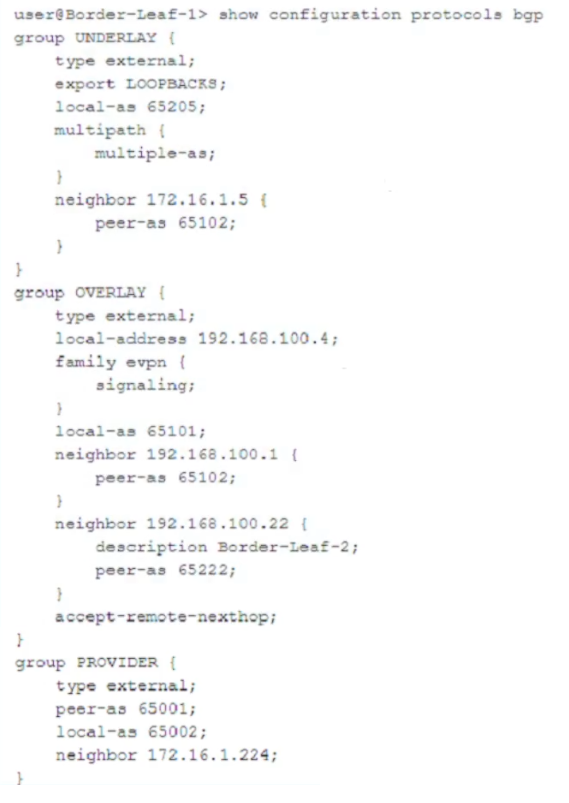
You are troubleshooting a DCI connection to another data center. The BGP session to the provider is established, but the session to Border-Leaf-2 is not established.
Referring to the exhibit, which configuration change should be made to solve this problem?
- delete protocols bgp group UNDERLAY advertise-external
- set protocols bgp group PROVIDER export LOOPBACKS
- set protocols bgp group OVERLAY export LOOPBACKS
- delete protocols bgp group OVERLAY accept-remote-nexthop
Correct answer: C
Question 8
You are implementing seamless stitching between two data centers and have a proposed configuration for a border leaf device.
In this scenario, which two statements are correct? (Choose two.)
- The ESI must match in both data centers.
- The translation-vni must match in both data centers.
- The translation-vni must be different in each data center.
- The ESI must be different in each data center.
Correct answer: A, C
Question 9
Click the Exhibit button.
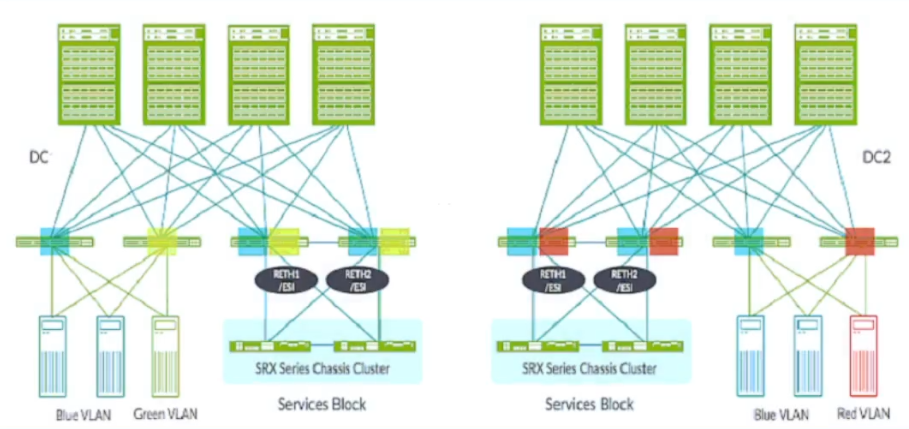
Both DC and DC2 are using EVPN-VXLAN technology deployed using an ERB architecture. A server on the Red VLAN must communicate with a server on the Green VLAN. The Blue VLAN in DC and DC2 needs to be the same VLAN.
Which statement is correct?
- An interconnect is required between four leaf devices in the services blocks; the Red VLAN and the Green VLAN must be stitched and the Blue VLAN must be stretched.
- An interconnect is required between the four SRX Series devices; the Blue VLAN must be stretched and a transit VNI must be added for the Red and Green VLANs.
- A lean super spine device must be added to DC and DC2; all VLANs must be stretched to the lean super spine device and the lean super spine devices must stitch all the VLANs together.
- The eight spine devices must be configured as border spine devices; a full mush interconnect must exist between all eight spine devices and the Blue VLAN must be stitched together.
Correct answer: B
Question 10
Which three statements are correct about symmetric IRB routing with EVPN Type 2 routes? (Choose three.)
- An L3 interface (IRB) is required for each local VLAN.
- Symmetric routing requires MAC-VRF.
- Symmetric routing is less efficient than asymmetric routing.
- Symmetric routing supports the EVPN service VLAN bundle.
- Symmetric routing requires an extra transit VNI for each VRF.
Correct answer: A, B, D
Question 11
Click the Exhibit button.
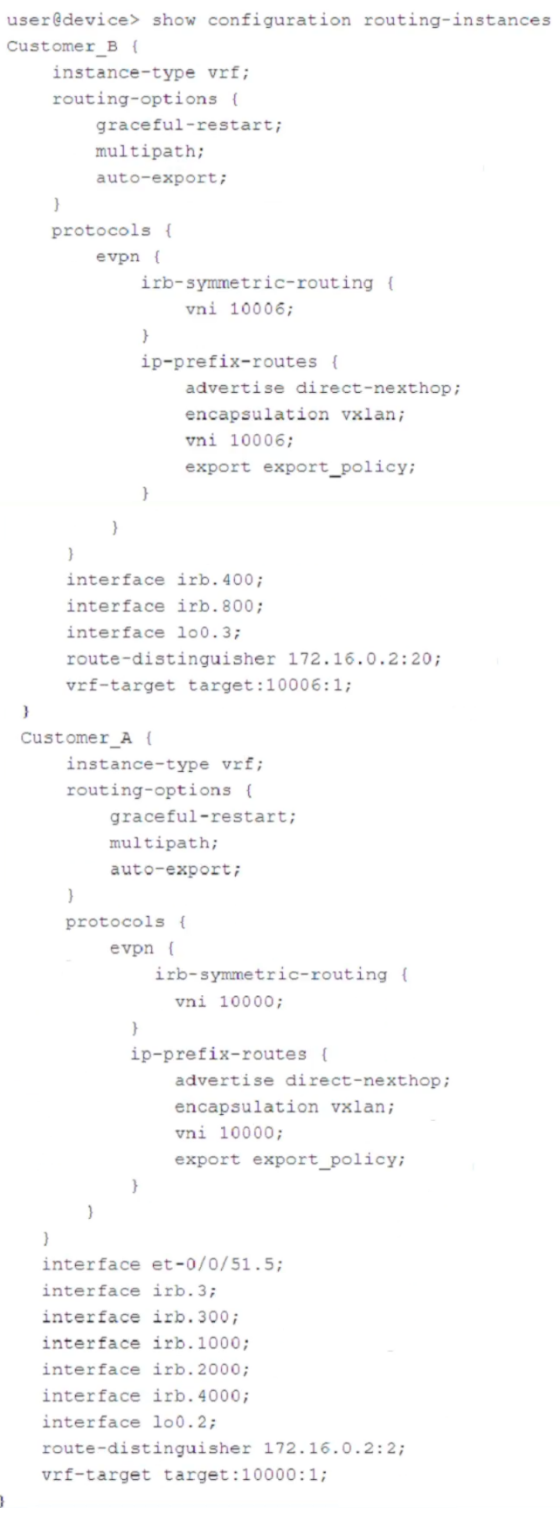
Referring to the configuration shown in the exhibit, assume that there is no external router present and that the configuration is fabric-only.
Which two statements are true about the example configuration? (Choose two.)
- Devices in irb.400 (vlan 400) and irb.800 (vlan 800) are able to communicate over the fabric.
- Devices in irb.400 (vlan 400) are not able to communicate directly with devices in routing instance Customer A.
- Devices in routing instance Customer A are able to communicate with devices in routing instance Customer B.
- VNI 10006 is assigned to vlan 800 (irb.800).
Correct answer: B, D
HOW TO OPEN VCE FILES
Use VCE Exam Simulator to open VCE files
HOW TO OPEN VCEX FILES
Use ProfExam Simulator to open VCEX files
ProfExam at a 20% markdown
You have the opportunity to purchase ProfExam at a 20% reduced price
Get Now!