Download Implementing Data Engineering Solutions Using Microsoft Fabric.DP-700.ExamTopics.2025-06-11.55q.tqb
| Vendor: | Microsoft |
| Exam Code: | DP-700 |
| Exam Name: | Implementing Data Engineering Solutions Using Microsoft Fabric |
| Date: | Jun 11, 2025 |
| File Size: | 3 MB |
How to open TQB files?
Files with TQB (Taurus Question Bank) extension can be opened by Taurus Exam Studio.
Purchase
Coupon: TAURUSSIM_20OFF
Discount: 20%
Demo Questions
Question 1
Case Study
This is a case study. Case studies are not timed separately. You can use as much exam time as you would like to complete each case. However, there may be additional case studies and sections on this exam. You must manage your time to ensure that you are able to complete all questions included on this exam in the time provided.
To answer the questions included in a case study, you will need to reference information that is provided in the case study. Case studies might contain exhibits and other resources that provide more information about the scenario that is described in the case study. Each question is independent of the other questions in this case study.
At the end of this case study, a review screen will appear. This screen allows you to review your answers and to make changes before you move to the next section of the exam. After you begin a new section, you cannot return to this section.
To start the case study
To display the first question in this case study, click the Next button. Use the buttons in the left pane to explore the content of the case study before you answer the questions.
Clicking these buttons displays information such as business requirements, existing environment, and problem statements. If the case study has an All Information tab, note that the information displayed is identical to the information displayed on the subsequent tabs. When you are ready to answer a question, click the Question button to return to the question.
Overview. Company Overview
Contoso, Ltd. is an online retail company that wants to modernize its analytics platform by moving to Fabric. The company plans to begin using Fabric for marketing analytics.
Overview. IT Structure
The company’s IT department has a team of data analysts and a team of data engineers that use analytics systems.
The data engineers perform the ingestion, transformation, and loading of data. They prefer to use Python or SQL to transform the data.
The data analysts query data and create semantic models and reports. They are qualified to write queries in Power Query and T-SQL.
Existing Environment. Fabric
Contoso has an F64 capacity named Cap1. All Fabric users are allowed to create items.
Contoso has two workspaces named WorkspaceA and WorkspaceB that currently use Pro license mode.
Existing Environment. Source Systems
Contoso has a point of sale (POS) system named POS1 that uses an instance of SQL Server on Azure Virtual Machines in the same Microsoft Entra tenant as Fabric. The host virtual machine is on a private virtual network that has public access blocked. POS1 contains all the sales transactions that were processed on the company’s website.
The company has a software as a service (SaaS) online marketing app named MAR1. MAR1 has seven entities. The entities contain data that relates to email open rates and interaction rates, as well as website interactions. The data can be exported from MAR1 by calling REST APIs. Each entity has a different endpoint.
Contoso has been using MAR1 for one year. Data from prior years is stored in Parquet files in an Amazon Simple Storage Service (Amazon S3) bucket. There are 12 files that range in size from 300 MB to 900 MB and relate to email interactions.
Existing Environment. Product Data
POS1 contains a product list and related data. The data comes from the following three tables:
- Products
- ProductCategories
- ProductSubcategories
In the data, products are related to product subcategories, and subcategories are related to product categories.
Existing Environment. Azure
Contoso has a Microsoft Entra tenant that has the following mail-enabled security groups:
- DataAnalysts: Contains the data analysts
- DataEngineers: Contains the data engineers
Contoso has an Azure subscription.
The company has an existing Azure DevOps organization and creates a new project for repositories that relate to Fabric.
Existing Environment. User Problems
The VP of marketing at Contoso requires analysis on the effectiveness of different types of email content. It typically takes a week to manually compile and analyze the data. Contoso wants to reduce the time to less than one day by using Fabric.
The data engineering team has successfully exported data from MAR1. The team experiences transient connectivity errors, which causes the data exports to fail.
Requirements. Planned Changes
Contoso plans to create the following two lakehouses:
- Lakehouse1: Will store both raw and cleansed data from the sources
- Lakehouse2: Will serve data in a dimensional model to users for analytical queries
Additional items will be added to facilitate data ingestion and transformation.
Contoso plans to use Azure Repos for source control in Fabric.
Requirements. Technical Requirements
The new lakehouses must follow a medallion architecture by using the following three layers: bronze, silver, and gold. There will be extensive data cleansing required to populate the MAR1 data in the silver layer, including deduplication, the handling of missing values, and the standardizing of capitalization.
Each layer must be fully populated before moving on to the next layer. If any step in populating the lakehouses fails, an email must be sent to the data engineers.
Data imports must run simultaneously, when possible.
The use of email data from the Amazon S3 bucket must meet the following requirements:
- Minimize egress costs associated with cross-cloud data access.
- Prevent saving a copy of the raw data in the lakehouses.
Items that relate to data ingestion must meet the following requirements:
- The items must be source controlled alongside other workspace items.
- Ingested data must land in the bronze layer of Lakehouse1 in the Delta format.
- No changes other than changes to the file formats must be implemented before the data lands in the bronze layer.
- Development effort must be minimized and a built-in connection must be used to import the source data.
- In the event of a connectivity error, the ingestion processes must attempt the connection again.
Lakehouses, data pipelines, and notebooks must be stored in WorkspaceA. Semantic models, reports, and dataflows must be stored in WorkspaceB.
Once a week, old files that are no longer referenced by a Delta table log must be removed.
Requirements. Data Transformation
In the POS1 product data, ProductID values are unique. The product dimension in the gold layer must include only active products from product list. Active products are identified by an IsActive value of 1.
Some product categories and subcategories are NOT assigned to any product. They are NOT analytically relevant and must be omitted from the product dimension in the gold layer.
Requirements. Data Security
Security in Fabric must meet the following requirements:
- The data engineers must have read and write access to all the lakehouses, including the underlying files.
- The data analysts must only have read access to the Delta tables in the gold layer.
- The data analysts must NOT have access to the data in the bronze and silver layers.
- The data engineers must be able to commit changes to source control in WorkspaceA.
You need to ensure that the data analysts can access the gold layer lakehouse.
What should you do?
- Add the DataAnalyst group to the Viewer role for WorkspaceA.
- Share the lakehouse with the DataAnalysts group and grant the Build reports on the default semantic model permission.
- Share the lakehouse with the DataAnalysts group and grant the Read all SQL Endpoint data permission.
- Share the lakehouse with the DataAnalysts group and grant the Read all Apache Spark permission.
Correct answer: C
Question 2
You have a Fabric warehouse named DW1. DW1 contains a table that stores sales data and is used by multiple sales representatives.
You plan to implement row-level security (RLS).
You need to ensure that the sales representatives can see only their respective data.
Which warehouse object do you require to implement RLS?
- STORED PROCEDURE
- CONSTRAINT
- SCHEMA
- FUNCTION
Correct answer: D
Question 3
You have a Fabric workspace named Workspace1_DEV that contains the following items:
- 10 reports
- Four notebooks
- Three lakehouses
- Two data pipelines
- Two Dataflow Gen1 dataflows
- Three Dataflow Gen2 dataflows
Five semantic models that each has a scheduled refresh policy
You create a deployment pipeline named Pipeline1 to move items from Workspace1_DEV to a new workspace named Workspace1_TEST.
You deploy all the items from Workspace1_DEV to Workspace1_TEST.
For each of the following statements, select Yes if the statement is true. Otherwise, select No.
NOTE: Each correct selection is worth one point.
Correct answer: To work with this question, an Exam Simulator is required.
Question 4
You have a Fabric deployment pipeline that uses three workspaces named Dev, Test, and Prod.
You need to deploy an eventhouse as part of the deployment process.
What should you use to add the eventhouse to the deployment process?
- GitHub Actions
- a deployment pipeline
- an Azure DevOps pipeline
Correct answer: B
Question 5
You have a Fabric workspace that contains a lakehouse named Lakehouse1.
In an external data source, you have data files that are 500 GB each. A new file is added every day.
You need to ingest the data into Lakehouse1 without applying any transformations. The solution must meet the following requirements
Trigger the process when a new file is added.
Provide the highest throughput.
Which type of item should you use to ingest the data?
- Eventstream
- Dataflow Gen2
- Streaming dataset
- Data pipeline
Correct answer: D
Question 6
You have a Fabric workspace that contains a Real-Time Intelligence solution and an eventhouse.
Users report that from OneLake file explorer, they cannot see the data from the eventhouse.
You enable OneLake availability for the eventhouse.
What will be copied to OneLake?
- only data added to new databases that are added to the eventhouse
- only the existing data in the eventhouse
- no data
- both new data and existing data in the eventhouse
- only new data added to the eventhouse
Correct answer: E
Question 7
You have a Fabric workspace named Workspace1.
You plan to integrate Workspace1 with Azure DevOps.
You will use a Fabric deployment pipeline named deployPipeline1 to deploy items from Workspace1 to higher environment workspaces as part of a medallion architecture. You will run deployPipeline1 by using an API call from an Azure DevOps pipeline.
You need to configure API authentication between Azure DevOps and Fabric.
Which type of authentication should you use?
- service principal
- Microsoft Entra username and password
- managed private endpoint
- workspace identity
Correct answer: A
Question 8
You have a Google Cloud Storage (GCS) container named storage1 that contains the files shown in the following table.
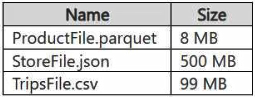
You have a Fabric workspace named Workspace1 that has the cache for shortcuts enabled. Workspace1 contains a lakehouse named Lakehouse1. Lakehouse1 has the shortcuts shown in the following table.
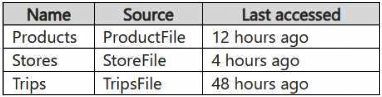
You need to read data from all the shortcuts.
Which shortcuts will retrieve data from the cache?
- Stores only
- Products only
- Stores and Products only
- Products, Stores, and Trips
- Trips only
- Products and Trips only
Correct answer: C
Question 9
You have a Fabric workspace named Workspace1 that contains an Apache Spark job definition named Job1.
You have an Azure SQL database named Source1 that has public internet access disabled.
You need to ensure that Job1 can access the data in Source1.
What should you create?
- an on-premises data gateway
- a managed private endpoint
- an integration runtime
- a data management gateway
Correct answer: B
Question 10
You have an Azure Data Lake Storage Gen2 account named storage1 and an Amazon S3 bucket named storage2.
You have the Delta Parquet files shown in the following table.

You have a Fabric workspace named Workspace1 that has the cache for shortcuts enabled. Workspace1 contains a lakehouse named Lakehouse1. Lakehouse1 has the following shortcuts:
- A shortcut to ProductFile aliased as Products
- A shortcut to StoreFile aliased as Stores
- A shortcut to TripsFile aliased as Trips
The data from which shortcuts will be retrieved from the cache?
- Trips and Stores only
- Products and Store only
- Stores only
- Products only
- Products, Stores, and Trips
Correct answer: C
HOW TO OPEN VCE FILES
Use VCE Exam Simulator to open VCE files
HOW TO OPEN VCEX FILES
Use ProfExam Simulator to open VCEX files
ProfExam at a 20% markdown
You have the opportunity to purchase ProfExam at a 20% reduced price
Get Now!