Download JD Edwards EnterpriseOne Financial Management 9.2 Implementation Essentials.1z0-342.Pass4Success.2026-01-03.115q.tqb
| Vendor: | Oracle |
| Exam Code: | 1z0-342 |
| Exam Name: | JD Edwards EnterpriseOne Financial Management 9.2 Implementation Essentials |
| Date: | Jan 03, 2026 |
| File Size: | 430 KB |
How to open TQB files?
Files with TQB (Taurus Question Bank) extension can be opened by Taurus Exam Studio.
Purchase
Coupon: TAURUSSIM_20OFF
Discount: 20%
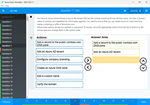
Demo Questions
Question 1
For which set of fields can you control changes or additions on Payee control?
- Payee Number in the Accounts Payable Ledger table. Alpha Name in the Address Book Master table, and Bank Account Number in the Bank Master Transit table
- Alpha Name in the Address Book - Who's Who table. Payee Number in the Accounts Payable Ledger table, Bank Account Number in the Bank Master Transit table, and Amount in the Accounts Payable Ledger table
- Alpha Name in the Address Book Master table, Bank Account Number in the Bank Master Transit table, and Amount in the Accounts Payable Ledger table
- Alpha Name in the Address Book - Who's Who table, Payee Number in the Accounts Payable Ledger table, and Alpha Name in the Address Book Master table
Correct answer: C
Question 2
You have a clearing account that is out of balance and you elect to use the Debit/Credit Match program to assist in the reconciliation. Which four steps are required?
- Running the Bank Journal Statement Process.
- Refreshing account information in the Account Ledger Reconciliation table.
- Reconciling void payments and receipts.
- Unreconciling transactions when needed.
- Manually Reconciling transactions.
Correct answer: B, C, D, E
Explanation:
isp3.ca/wp-content/uploads/2011/08/Yamana_isp3.pdf isp3.ca/wp-content/uploads/2011/08/Yamana_isp3.pdf
Question 3
Which two statements are TRUE about Environments?
- An Environment can have a unique set of Data and share its Objects with another Environment.
- An Environment always has a unique set of Objects and Data.
- A user has to log in to JDE through an Environment.
- The Environment can be selected or changed by the user after logging in to JDE.
- An Environment always shares its Objects and Data with another Environment.
Correct answer: A, C
Question 4
Your client has posted a fixed asset journal entry to the G/L but is getting errors when trying to post the entry to fixed assets.
Which two statements correctly indicate reasons for the entry not getting posted?
- The entry has a fixed asset post code of P.
- The entry has a hold code of blank,
- The entry has a GL post code of P.
- The entry contains accounts within the FX range of AAIs.
- The entry does not contain an asset number.
Correct answer: A, D
Question 5
When you enter a voucher with tax In the Standard Voucher Entry application (P0411), error 0886: "Tax Area Required" is displayed on the GL distribution.
Which three actions should you take to resolve the error?
- Deactivate the Tax Capture Constant for the company you are entering transactions.
- Change the voucher transaction Business Unit to a nontaxable entity.
- Blank out the Track Tax field for the GL distribution line item.
- Populate the Tax/Rate Area for the expense entry in the GL distribution.
- Change the Expense Account to a nontaxable account in the Account Master.
- Populate the Subledger field to a taxable Supplier Address Book number.
Correct answer: A
Question 6
What three conditions must exist In order for one to use the Composite Application Framework?
- You should have access to the content in the layout.
- You should have access to Object Management Workbench (OMW).
- You should have the permission to publish content.
- You should be enabled to view the layout of the Composite Application Framework.
- Your Enterprise One preferences should have the Show Layout option selected.
Correct answer: C, D, E
Question 7
When you try to delete an Invoice, the system displays error 0415: "Delete Invalid for this Voucher/Invoice".
What is the reason for this?
- The invoice is linked to a sales order and, therefore, cannot be deleted.
- The Invoice is paid and, therefore, cannot be deleted.
- The invoice was not posted and, therefore, cannot be deleted.
- The Customer is on credit hold and, therefore, cannot be deleted.
- The processing options for Invoice Entry Master Business Function (P03B0011) are set to disallow deletion of invoices.
Correct answer: C
Question 8
A client uses multiple banks' accounts in their Accounts Payable System. The client wants the correct bank account number to be supplied by the system when they enter vouchers. What is the best choice to accomplish this function?
- Set up bank account information to override PB.
- Set up G/L offset in the Supplier Master and set up PCyyyy only.
- Set up G/L offset in the Supplier Master and set up PByyyy and Pcyyyy.
- Set up 6/L offset in the Supplier Master and set up PByyyy only.
- Set up G/L offset hi Supplier Billing and set up PByyyy and PCyyyy.
Correct answer: C
Explanation:
download.oracle.com/docs/cd/B28729_01/jded/acrobat/b7331ceaap.pdf download.oracle.com/docs/cd/B28729_01/jded/acrobat/b7331ceaap.pdf
Question 9
How can you alert the credit manager when an account is over Its credit limit?
- Set up a Watchlist containing customers who have exceeded their credit limits.
- Set up a Watchlist containing customers and their credit limits.
- Set up a Watchlist containing approved customer credit limits.
- Set up a Watchlist to send email notification to customers who have exceeded their credit limits.
Correct answer: B
Question 10
You were asked to assist a Technical developer who is modifying a standard online inquiry In EnterprtseOne. The developer wants to understand how the Cumulative Prior Year End balance is calculated.
Which statement is TRUE of the Cumulative Prior Year End balances for Income Statement accounts when you view online?
- The Cumulative Prior Year End balances shows posted and non-posted balances for the prior year end.
- The Cumulative Prior Year End balances show the same type of balances that the balance sheet does.
- The Cumulative Prior Year End balances include the Net Posting amounts for the prior year end.
- The Cumulative Prior Year End balances do not include the Net Posting amount for the prior year end.
- The Cumulative Prior Year End balances include the Net Posting amounts for only domestic entries for the prior year end.
Correct answer: C
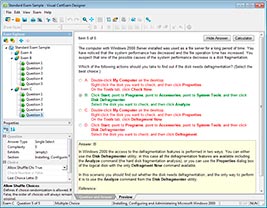
HOW TO OPEN VCE FILES
Use VCE Exam Simulator to open VCE files
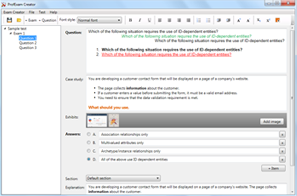
HOW TO OPEN VCEX FILES
Use ProfExam Simulator to open VCEX files
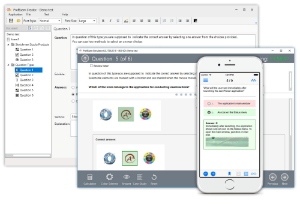
ProfExam at a 20% markdown
You have the opportunity to purchase ProfExam at a 20% reduced price
Get Now!