Download SAP Certified Associate - Back-End Developer - ABAP Cloud.C_ABAPD_2309.Pass4Success.2025-11-22.38q.vcex
| Vendor: | SAP |
| Exam Code: | C_ABAPD_2309 |
| Exam Name: | SAP Certified Associate - Back-End Developer - ABAP Cloud |
| Date: | Nov 22, 2025 |
| File Size: | 424 KB |
How to open VCEX files?
Files with VCEX extension can be opened by ProfExam Simulator.
Purchase
Coupon: TAURUSSIM_20OFF
Discount: 20%
Demo Questions
Question 1
In which products must you use the ABAP Cloud Development Model? Note: There are 2 correct answers to this Question .
- SAP S/4HANA Cloud, private edition
- SAP BTP, ABAP environment
- SAP S/4HANA on premise
- SAP S/4HANA Cloud, public edition
Correct answer: B, D
Question 2
Given the following code in an SAP S/4HANA Cloud private edition tenant:
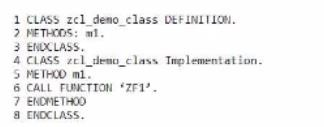
The class zcl_demo_class is in a software component with the language version set to "ABAP Cloud". The function module ZF1' is in a different software component with the language version set to "Standard ABAP". Both the class and function module are customer created.
Regarding line #6, which of the following are valid statements? Note: There are 2 correct answers to this Question .
- ZF1' can be called only if it is released for cloud development.
- 'ZF1' can be called if a wrapper is created for it and the wrapper itself is released for cloud development.
- 'ZF1' can be called whether it is released or not for cloud development
- ZF1' can be called if a wrapper is created for it but the wrapper itself is not released for cloud development.
Correct answer: B, C
Question 3
Which function call returns 0?
- Count_any_of ( val - 'ABAP ABAP abap' sub 'AB' )
- Count (val - 'ABAP ABAP abap' sub - 'AB' )
- find_any_of (val = 'ABAP ABAP abap' sub = 'AB')
- find_any_not_of( val 'ABAP ABAP abap' sub = 'AB')
Correct answer: B
Question 4
Which of the following are ABAP Cloud Development Model rules?
- Note: There are 2 correct answers to this question.
- Use public SAP APIs and SAP extension points.
- Build ABAP RESTful application programming model-based services.
- Reverse modifications when a suitable public SAP API becomes available.
- Build ABAP reports with either ABAP List Viewer (ALV) or SAP Fiori.
Correct answer: A
Explanation:
Use public SAP APIs and SAP extension points. This rule ensures that the ABAP Cloud code is stable, reliable, and compatible with the SAP solutions and the cloud operations. Public SAP APIs and SAP extension points are the only allowed interfaces and objects to access the SAP platform and the SAP applications. They are documented, tested, and supported by SAP.They also guarantee the lifecycle stability and the upgradeability of the ABAP Cloud code1.Build ABAP RESTful application programming model-based services. This rule ensures that the ABAP Cloud code follows the state-of-the-art development paradigm for building cloud-ready business services. The ABAP RESTful application programming model (RAP) is a framework that provides a consistent end-to-end programming model for creating, reading, updating, and deleting (CRUD) business data. RAP also supports draft handling, authorization checks, side effects, validations, and custom actions.RAP exposes the business services as OData services that can be consumed by SAP Fiori apps or other clients2. Use public SAP APIs and SAP extension points. This rule ensures that the ABAP Cloud code is stable, reliable, and compatible with the SAP solutions and the cloud operations. Public SAP APIs and SAP extension points are the only allowed interfaces and objects to access the SAP platform and the SAP applications. They are documented, tested, and supported by SAP.They also guarantee the lifecycle stability and the upgradeability of the ABAP Cloud code1.
Build ABAP RESTful application programming model-based services. This rule ensures that the ABAP Cloud code follows the state-of-the-art development paradigm for building cloud-ready business services. The ABAP RESTful application programming model (RAP) is a framework that provides a consistent end-to-end programming model for creating, reading, updating, and deleting (CRUD) business dat
a. RAP also supports draft handling, authorization checks, side effects, validations, and custom actions.RAP exposes the business services as OData services that can be consumed by SAP Fiori apps or other clients2.
Question 5
Which RESTful Application Programming object can be used to organize the display of fields in an app?
- Data model view
- Metadata extension
- Service definition
- Projection view
Correct answer: D
Question 6
Refer to exhibit.
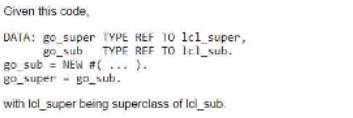
When accessing the subclass instance through go_super, what can you do? Note: There are 2 correct answers to this Question .
- Access the inherited private components.
- Access the inherited public components.
- Call a subclass specific public method
- Call inherited public redefined methods.
Correct answer: B, C
Question 7
For the assignment, gv_target = gv_source.
which of the following data declarations will always work without truncation or rounding?
Note: There are 2 correct answers to this question.
- DATA gv_source TYPE string, to DATA gv_target TYPE c.
- DATA gv_source TYPE c. to DATA gv_target TYPE string.
- DATA gv_source TYPE d. to DATA gv_target TYPE string.
- DATA gv_source TYPE p LENGTH 8 DECIMALS 3. to DATA gv_target TYPE p LENGTH 16 DECIMALS 2.
Correct answer: B, C
Explanation:
The data declarations that will always work without truncation or rounding for the assignment gv_target = gv_source are B and C. This is because the target data type string is a variable-length character type that can hold any character string, including those of data types c (fixed-length character) and d (date).The assignment of a character or date value to a string variable will not cause any loss of information or precision, as the string variable will adjust its length to match the source value12.You cannot do any of the following:A) DATA gv_source TYPE string, to DATA gv_target TYPE c.: This data declaration may cause truncation for the assignment gv_target = gv_source. This is because the target data type c is a fixed-length character type that has a predefined length.If the source value of type string is longer than the target length of type c, the source value will be truncated on the right to fit the target length12.D) DATA gv_source TYPE p LENGTH 8 DECIMALS 3. to DATA gv_target TYPE p LENGTH 16 DECIMALS 2.: This data declaration may cause rounding for the assignment gv_target = gv_source. This is because the target data type p is a packed decimal type that has a predefined length and number of decimal places.If the source value of type p has more decimal places than the target type p, the source value will be rounded to the target number of decimal places12. The data declarations that will always work without truncation or rounding for the assignment gv_target = gv_source are B and C. This is because the target data type string is a variable-length character type that can hold any character string, including those of data types c (fixed-length character) and d (date).The assignment of a character or date value to a string variable will not cause any loss of information or precision, as the string variable will adjust its length to match the source value12.
You cannot do any of the following:
A) DATA gv_source TYPE string, to DATA gv_target TYPE c.: This data declaration may cause truncation for the assignment gv_target = gv_source. This is because the target data type c is a fixed-length character type that has a predefined length.If the source value of type string is longer than the target length of type c, the source value will be truncated on the right to fit the target length12.
D) DATA gv_source TYPE p LENGTH 8 DECIMALS 3. to DATA gv_target TYPE p LENGTH 16 DECIMALS 2.: This data declaration may cause rounding for the assignment gv_target = gv_source. This is because the target data type p is a packed decimal type that has a predefined length and number of decimal places.If the source value of type p has more decimal places than the target type p, the source value will be rounded to the target number of decimal places12.
Question 8
In a test method you call method cl_abap_unit_assert=>assert_equals( .. ) in the following way:
CLASS Itcl1 DEFINITION FOR TESTING RISK LEVEL HARMLESS DURATION SHORT.
PRIVATE SECTION.
METHODS m1 FOR TESTING.
ENDCLASS.
CLASS Itcl1 IMPLEMENTATION.
METHOD m1.
DATA: go_test_object TYPE REF TO zcl_to_be_tested.
CONSTANTS: Ico_exp TYPE string VALUE 'test2'.
CREATE OBJECT go_test_object.
cl_abap_unit_assert=>assert_equals(
EXPORTING
act = go_class->mv_attribute
exp = lco_exp
msg = 'assert equals failed ' && go_test_object->mv_attribute && ' ' && lco_exp
ENDMETHOD.
ENDCLASS.
What will happen if method parameters act and exp are not equal?
- The tested unit will automatically be appended to a default ABAP Test Cockpit Variant.
- The tested unit cannot be transported.
- The test will be aborted.
- There will be a message in the test log.
Correct answer: D
Question 9
Which of the following are incomplete ABAP types? Note: There are 2 correct answers to this question.
- String
- T
- C
- P
Correct answer: C, D
Explanation:
Incomplete ABAP types are types that do not specify all the attributes of a data type, such as the length, the number of decimal places, or the value range. Incomplete types can only be used for the typing of field symbols and formal parameters, not for the definition of data objects or constants.Incomplete types can be either predefined or user-defined1.The following are incomplete ABAP types:C) C is a type for character strings with a generic length. The length of the character string has to be specified when a data object or a constant is defined with this type.For example, DATA text TYPE c LENGTH 10 defines a data object named text with a type c and a length of 10 characters2.D) P is a type for packed numbers with a generic length and a generic number of decimal places. The length and the number of decimal places of the packed number have to be specified when a data object or a constant is defined with this type.For example, DATA amount TYPE p LENGTH 8 DECIMALS 2 defines a data object named amount with a type p, a length of 8 bytes, and 2 decimal places3.The following are not incomplete ABAP types, because they specify all the attributes of a data type:A) String is a type for variable-length character strings. The length of the character string is determined at runtime and can vary from 0 to 2,147,483,647 characters. The length does not have to be specified when a data object or a constant is defined with this type.For example, DATA text TYPE string defines a data object named text with a type string and a variable length4.B) T is a type for time values in the format HHMMSS. The length of the time value is fixed at 6 characters and does not have to be specified when a data object or a constant is defined with this type. For example, DATA time TYPE t defines a data object named time with a type t and a length of 6 characters. Incomplete ABAP types are types that do not specify all the attributes of a data type, such as the length, the number of decimal places, or the value range. Incomplete types can only be used for the typing of field symbols and formal parameters, not for the definition of data objects or constants.Incomplete types can be either predefined or user-defined1.
The following are incomplete ABAP types:
C) C is a type for character strings with a generic length. The length of the character string has to be specified when a data object or a constant is defined with this type.For example, DATA text TYPE c LENGTH 10 defines a data object named text with a type c and a length of 10 characters2.
D) P is a type for packed numbers with a generic length and a generic number of decimal places. The length and the number of decimal places of the packed number have to be specified when a data object or a constant is defined with this type.For example, DATA amount TYPE p LENGTH 8 DECIMALS 2 defines a data object named amount with a type p, a length of 8 bytes, and 2 decimal places3.
The following are not incomplete ABAP types, because they specify all the attributes of a data type:
A) String is a type for variable-length character strings. The length of the character string is determined at runtime and can vary from 0 to 2,147,483,647 characters. The length does not have to be specified when a data object or a constant is defined with this type.For example, DATA text TYPE string defines a data object named text with a type string and a variable length4.
B) T is a type for time values in the format HHMMSS. The length of the time value is fixed at 6 characters and does not have to be specified when a data object or a constant is defined with this type. For example, DATA time TYPE t defines a data object named time with a type t and a length of 6 characters.
Question 10
Exhibit:
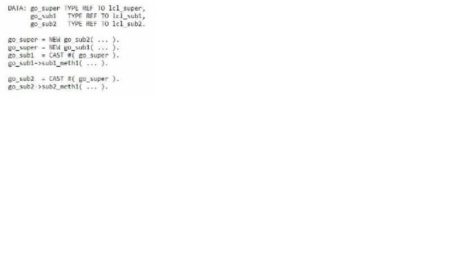
With Icl_super being superclass for Icl_subl and Icl_sub2 and with methods subl_methl and sub2_methl being subclass-specific methods of Id_subl or Icl_sub2, respectivel. What will happen when executing these casts? Note:
There are 2 correct answers to this question
- go subl = CAST # go super), will not work
- go_sub2 = CAST # go super), will work. go_subl CAST #go_super), will work
- go_sub2 = CAST #(go_super). will not work. ] go sub2->sub2 meth 1(...). will work
- go_subl->subl_meth !(...)* w'll work.
Correct answer: A, D
Explanation:
The following are the explanations for each statement:A: This statement is correct. go_subl = CAST #(go_super) will not work. This is because go_subl is a data object of type REF TO cl_subl, which is a reference to the subclass cl_subl. go_super is a data object of type REF TO cl_super, which is a reference to the superclass cl_super. The CAST operator is used to perform a downcast or an upcast of a reference variable to another reference variable of a compatible type. A downcast is a conversion from a more general type to a more specific type, while an upcast is a conversion from a more specific type to a more general type. In this case, the CAST operator is trying to perform a downcast from go_super to go_subl, but this is not possible, as go_super is not pointing to an instance of cl_subl, but to an instance of cl_super.Therefore, the CAST operator will raise an exception CX_SY_MOVE_CAST_ERROR at runtime12B: This statement is incorrect. go_sub2 = CAST #(go_super) will work. go_subl = CAST #(go_super) will not work. This is because go_sub2 is a data object of type REF TO cl_sub2, which is a reference to the subclass cl_sub2. go_super is a data object of type REF TO cl_super, which is a reference to the superclass cl_super. The CAST operator is used to perform a downcast or an upcast of a reference variable to another reference variable of a compatible type. A downcast is a conversion from a more general type to a more specific type, while an upcast is a conversion from a more specific type to a more general type. In this case, the CAST operator is trying to perform a downcast from go_super to go_sub2, and this is possible, as go_super is pointing to an instance of cl_sub2, which is a subclass of cl_super. Therefore, the CAST operator will assign the reference of go_super to go_sub2 without raising an exception.However, the CAST operator will not work for go_subl, as explained in statement A12C: This statement is incorrect. go_sub2 = CAST #(go_super) will work. go_sub2->sub2_meth1(...) will not work. This is because go_sub2 is a data object of type REF TO cl_sub2, which is a reference to the subclass cl_sub2. go_super is a data object of type REF TO cl_super, which is a reference to the superclass cl_super. The CAST operator is used to perform a downcast or an upcast of a reference variable to another reference variable of a compatible type. A downcast is a conversion from a more general type to a more specific type, while an upcast is a conversion from a more specific type to a more general type. In this case, the CAST operator is trying to perform a downcast from go_super to go_sub2, and this is possible, as go_super is pointing to an instance of cl_sub2, which is a subclass of cl_super. Therefore, the CAST operator will assign the reference of go_super to go_sub2 without raising an exception. However, the method call go_sub2->sub2_meth1(...) will not work, as sub2_meth1 is a subclass-specific method of cl_sub2, which is not inherited by cl_super.Therefore, the method call will raise an exception CX_SY_DYN_CALL_ILLEGAL_METHOD at runtime123D: This statement is correct. go_subl->subl_meth1(...) will work. This is because go_subl is a data object of type REF TO cl_subl, which is a reference to the subclass cl_subl. subl_meth1 is a subclass-specific method of cl_subl, which is not inherited by cl_super.Therefore, the method call go_subl->subl_meth1(...) will work, as go_subl is pointing to an instance of cl_subl, which has the method subl_meth1123 The following are the explanations for each statement:
A: This statement is correct. go_subl = CAST #(go_super) will not work. This is because go_subl is a data object of type REF TO cl_subl, which is a reference to the subclass cl_subl. go_super is a data object of type REF TO cl_super, which is a reference to the superclass cl_super. The CAST operator is used to perform a downcast or an upcast of a reference variable to another reference variable of a compatible type. A downcast is a conversion from a more general type to a more specific type, while an upcast is a conversion from a more specific type to a more general type. In this case, the CAST operator is trying to perform a downcast from go_super to go_subl, but this is not possible, as go_super is not pointing to an instance of cl_subl, but to an instance of cl_super.Therefore, the CAST operator will raise an exception CX_SY_MOVE_CAST_ERROR at runtime12
B: This statement is incorrect. go_sub2 = CAST #(go_super) will work. go_subl = CAST #(go_super) will not work. This is because go_sub2 is a data object of type REF TO cl_sub2, which is a reference to the subclass cl_sub2. go_super is a data object of type REF TO cl_super, which is a reference to the superclass cl_super. The CAST operator is used to perform a downcast or an upcast of a reference variable to another reference variable of a compatible type. A downcast is a conversion from a more general type to a more specific type, while an upcast is a conversion from a more specific type to a more general type. In this case, the CAST operator is trying to perform a downcast from go_super to go_sub2, and this is possible, as go_super is pointing to an instance of cl_sub2, which is a subclass of cl_super. Therefore, the CAST operator will assign the reference of go_super to go_sub2 without raising an exception.However, the CAST operator will not work for go_subl, as explained in statement A12
C: This statement is incorrect. go_sub2 = CAST #(go_super) will work. go_sub2->sub2_meth1(...) will not work. This is because go_sub2 is a data object of type REF TO cl_sub2, which is a reference to the subclass cl_sub2. go_super is a data object of type REF TO cl_super, which is a reference to the superclass cl_super. The CAST operator is used to perform a downcast or an upcast of a reference variable to another reference variable of a compatible type. A downcast is a conversion from a more general type to a more specific type, while an upcast is a conversion from a more specific type to a more general type. In this case, the CAST operator is trying to perform a downcast from go_super to go_sub2, and this is possible, as go_super is pointing to an instance of cl_sub2, which is a subclass of cl_super. Therefore, the CAST operator will assign the reference of go_super to go_sub2 without raising an exception. However, the method call go_sub2->sub2_meth1(...) will not work, as sub2_meth1 is a subclass-specific method of cl_sub2, which is not inherited by cl_super.Therefore, the method call will raise an exception CX_SY_DYN_CALL_ILLEGAL_METHOD at runtime123
D: This statement is correct. go_subl->subl_meth1(...) will work. This is because go_subl is a data object of type REF TO cl_subl, which is a reference to the subclass cl_subl. subl_meth1 is a subclass-specific method of cl_subl, which is not inherited by cl_super.Therefore, the method call go_subl->subl_meth1(...) will work, as go_subl is pointing to an instance of cl_subl, which has the method subl_meth1123
Question 11
Given the following Core Data Service View Entity Data Definition:
1 @AccessControl.authorizationCheck: #NOT_REQUIRED
2 DEFINE VIEW ENTITY demo_flight_info_join
3 AS SELECT
4 FROM scarr AS a
5 LEFT OUTER JOIN scounter AS c
6 LEFT OUTER JOIN sairport AS p
7 ON p.id = c.airport
8 ON a.carrid = c.carrid
9 {
10 a.carrid AS carrier_id,
11 p.id AS airport_id,
12 c.countnum AS counter_number
13 }
In what order will the join statements be executed?
- scarr will be joined with scounter first and the result will be joined with sairport.
- sairport will be joined to scounter first and the result will be joined with scarr.
- scarr will be joined with sairport first and the result will be joined with scounter.
- scounter will be joined to sairport first and the result will be joined with scarr.
Correct answer: A
Explanation:
The order in which the join statements will be executed is:scarr will be joined with scounter first and the result will be joined with sairport.This is because the join statements are nested from left to right, meaning that the leftmost data source is joined with the next data source, and the result is joined with the next data source, and so on. The join condition for each pair of data sources is specified by the ON clause that follows the data source name. The join type for each pair of data sources is specified by the join operator that precedes the data source name. In this case, the join operator is LEFT OUTER JOIN, which means that all the rows from the left data source are included in the result, and only the matching rows from the right data source are included. If there is no matching row from the right data source, the corresponding fields are filled with initial values1.Therefore, the join statements will be executed as follows:First, scarr AS a will be joined with scounter AS c using the join condition a.carrid = c.carrid. This means that all the rows from scarr will be included in the result, and only the rows from scounter that have the same value for the carrid field will be included. If there is no matching row from scounter, the countnum field will be filled with an initial value.Second, the result of the first join will be joined with sairport AS p using the join condition p.id = c.airport. This means that all the rows from the first join will be included in the result, and only the rows from sairport that have the same value for the id field as the airport field from the first join will be included. If there is no matching row from sairport, the id field will be filled with an initial value. The order in which the join statements will be executed is:
scarr will be joined with scounter first and the result will be joined with sairport.
This is because the join statements are nested from left to right, meaning that the leftmost data source is joined with the next data source, and the result is joined with the next data source, and so on. The join condition for each pair of data sources is specified by the ON clause that follows the data source name. The join type for each pair of data sources is specified by the join operator that precedes the data source name. In this case, the join operator is LEFT OUTER JOIN, which means that all the rows from the left data source are included in the result, and only the matching rows from the right data source are included. If there is no matching row from the right data source, the corresponding fields are filled with initial values1.
Therefore, the join statements will be executed as follows:
First, scarr AS a will be joined with scounter AS c using the join condition a.carrid = c.carrid. This means that all the rows from scarr will be included in the result, and only the rows from scounter that have the same value for the carrid field will be included. If there is no matching row from scounter, the countnum field will be filled with an initial value.
Second, the result of the first join will be joined with sairport AS p using the join condition p.id = c.airport. This means that all the rows from the first join will be included in the result, and only the rows from sairport that have the same value for the id field as the airport field from the first join will be included. If there is no matching row from sairport, the id field will be filled with an initial value.
HOW TO OPEN VCE FILES
Use VCE Exam Simulator to open VCE files
HOW TO OPEN VCEX FILES
Use ProfExam Simulator to open VCEX files
ProfExam at a 20% markdown
You have the opportunity to purchase ProfExam at a 20% reduced price
Get Now!