Download SAP Certified Associate-Data Engineer-SAP HANA.C_HAMOD_2404.Pass4Success.2026-07-18.42q.vcex
| Vendor: | SAP |
| Exam Code: | C_HAMOD_2404 |
| Exam Name: | SAP Certified Associate-Data Engineer-SAP HANA |
| Date: | Jul 18, 2026 |
| File Size: | 207 KB |
How to open VCEX files?
Files with VCEX extension can be opened by ProfExam Simulator.
Purchase
Coupon: TAURUSSIM_20OFF
Discount: 20%
Demo Questions
Question 1
Why do you use the Hidden Columns checkbox in the semantics node of your calculation view? Note: There are 2 correct answers to this question.
- To avoid exposing sensitive columns when defining calculated columns
- To prevent passing columns in stacked calculation views
- To ensure specific columns are NOT exposed to the reporting tool
- To remove a column that is also used as a Label column
Correct answer: C, D
Question 2
What is generated when you build/deploy a CUBE calculation view design-time file? Note: There are 2 correct answers to this question.
- Metadata to enable consumption by external tools
- A column view in a container
- An SQL execution plan
- Cached results to improve read performance
Correct answer: A, B
Question 3
You created a calculation view that combines two tables in a join node. To improve the runtime of your calculation view, you use a referential join to prune data sources.
How do you check if pruning occurs? Note: There are 2 correct answers to this question.
- Check the SQL query generated by the Data Preview.
- Use the SQL Analyzer to identify the tables used.
- Enable the Debug Query mode to identify the source columns used.
- Observe which columns are mapped using the Performance Analysis mode.
Correct answer: C, D
Question 4
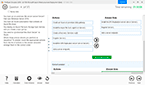
Using the table in the diagram, you need to create a cube calculation view. What is the simplest approach to create the output from the screenshot?
- Create a filter expression that uses an OR operator.
- Create 3 calculated columns.
- Implement a union node and map each year as a separate column.
- Create a restricted column for each year.
Correct answer: C
Question 5
You combine two tables in a join node using multiple columns in each table.
Why do you enable the dynamic join option? Note: There are 2 correct answers to this question.
- To force the calculation at the relevant level of granularity, even if this level is not the grouping level defined by the query
- To allow data analysis at different levels of granularity with the same calculation view
- To ensure that the aggregation always happens after the join execution
- To ensure that the join execution uses only the join columns requested in the query
Correct answer: B, D
Question 6
In a calculated column, which object do you use to process a dynamic value in an expression?
- Input Parameter
- Variable
- Table function
- Procedure
Correct answer: A
Question 7
In a calculation view, why would you choose the DEPRECATED setting? Note: There are 2 correct answers to this question.
- To warn developers that the calculation view is no longer supported
- To indicate that it should not be used as a data source to other calculation views
- To lock the calculation view from further modifications
- To redirect queries on this calculation view to another one
Correct answer: A, B
Question 8
Why do you use parameter mapping in a calculation view? Note: There are 2 correct answers to this question.
- To push down filters to the lowest level calculation views
- To convert the data types of input parameters
- To pass variable values to external value help views
- To assign variables to one or more attributes
Correct answer: A, C
Question 9
You are creating a procedure to be consumed in a DYNAMIC analytic privilege. What must you consider? Note: There are 2 correct answers to this question.
- The procedure should have the value DEFINER for the security mode
- The procedure should include an input parameter to specify the user ID
- The procedure should return a table with the list of allowed values
- The procedure should be defined as read-only
Correct answer: A, D
Question 10
Which of the following approaches might improve the performance of joins in a CUBE calculation view? Note: There are 2 correct answers to this question.
- Specify the join cardinality.
- Limit the number of joined columns.
- Define join direction in a full outer join.
- Use an inner join.
Correct answer: A, B
Question 11
What can you do with shared hierarchies? Note: There are 2 correct answers to this question.
- Provide reusable hierarchies for drilldown in a CUBE with star join
- Access hierarchies created in external schemas
- Provide reusable hierarchies for drilldown in a CUBE without star join
- Enable SQL SELECT statements to access hierarchies
Correct answer: A, D
HOW TO OPEN VCE FILES
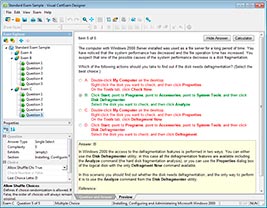
Use VCE Exam Simulator to open VCE files
HOW TO OPEN VCEX FILES
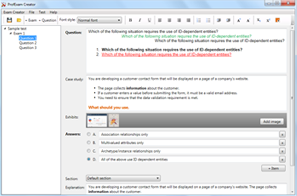
Use ProfExam Simulator to open VCEX files
ProfExam at a 20% markdown
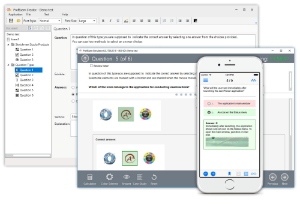
You have the opportunity to purchase ProfExam at a 20% reduced price
Get Now!