Download Professional Scrum Product Owner II.PSPO-II.Actual4Test.2026-11-10.74q.vcex
| Vendor: | Scrum |
| Exam Code: | PSPO-II |
| Exam Name: | Professional Scrum Product Owner II |
| Date: | Nov 10, 2026 |
| File Size: | 203 KB |
How to open VCEX files?
Files with VCEX extension can be opened by ProfExam Simulator.
Purchase
Coupon: TAURUSSIM_20OFF
Discount: 20%


Demo Questions
Question 1
Who is responsible for the Sprint Backlog?
- The Developers.
- The Scrum Master.
- The Product Owner.
- The Scrum Team.
Correct answer: A
Explanation:
The Sprint Backlog is one of the three Scrum artifacts, alongside the Product Backlog and the Increment. It is a dynamic plan that contains:* The selected Product Backlog items for the Sprint.* A plan for delivering the Increment and achieving the Sprint Goal.* The tasks and work needed to complete the selected items.The Scrum Guide explicitly states that the Sprint Backlog is owned and managed solely by the Developers.Analysis of Answer Choices:* Option A: The Developers (Correct)* The Developers create, maintain, and update the Sprint Backlog throughout the Sprint.* They have full ownership over their work and the plan required to meet the Sprint Goal.* As self-managing professionals, only the Developers decide how to accomplish their work.* Option B: The Scrum Master (Incorrect)* The Scrum Master is a servant leader and coach, not responsible for managing the Sprint Backlog.* They help the Scrum Team understand and follow Scrum practices, but they do not own or control artifacts.* Option C: The Product Owner (Incorrect)* The Product Owner manages the Product Backlog, ensuring it is prioritized to maximize value.* However, they do not dictate how work is done in a Sprint or modify the Sprint Backlog.* Option D: The Scrum Team (Incorrect)* While the Scrum Team (Developers, Product Owner, and Scrum Master) collaborates, the Sprint Backlog belongs exclusively to the Developers.Key Scrum Guide Principles Supporting This answer:* " The Sprint Backlog is a plan by and for the Developers. It is highly visible, real-time, and should be adapted as needed throughout the Sprint. "* " Only the Developers can change the Sprint Backlog during a Sprint. " Conclusion:The Developers are fully responsible for the Sprint Backlog. They create, modify, and own the plan to meet the Sprint Goal, ensuring agility and self-management. The Sprint Backlog is one of the three Scrum artifacts, alongside the Product Backlog and the Increment. It is a dynamic plan that contains:
* The selected Product Backlog items for the Sprint.
* A plan for delivering the Increment and achieving the Sprint Goal.
* The tasks and work needed to complete the selected items.
The Scrum Guide explicitly states that the Sprint Backlog is owned and managed solely by the Developers.
Analysis of Answer Choices:
* Option A: The Developers (Correct)
* The Developers create, maintain, and update the Sprint Backlog throughout the Sprint.
* They have full ownership over their work and the plan required to meet the Sprint Goal.
* As self-managing professionals, only the Developers decide how to accomplish their work.
* Option B: The Scrum Master (Incorrect)
* The Scrum Master is a servant leader and coach, not responsible for managing the Sprint Backlog.
* They help the Scrum Team understand and follow Scrum practices, but they do not own or control artifacts.
* Option C: The Product Owner (Incorrect)
* The Product Owner manages the Product Backlog, ensuring it is prioritized to maximize value.
* However, they do not dictate how work is done in a Sprint or modify the Sprint Backlog.
* Option D: The Scrum Team (Incorrect)
* While the Scrum Team (Developers, Product Owner, and Scrum Master) collaborates, the Sprint Backlog belongs exclusively to the Developers.
Key Scrum Guide Principles Supporting This answer:
* " The Sprint Backlog is a plan by and for the Developers. It is highly visible, real-time, and should be adapted as needed throughout the Sprint. "
* " Only the Developers can change the Sprint Backlog during a Sprint. " Conclusion:
The Developers are fully responsible for the Sprint Backlog. They create, modify, and own the plan to meet the Sprint Goal, ensuring agility and self-management.
Question 2
A new market opportunity has appeared and your organization will need to react quickly. In order to capture this valuable opportunity, you must accelerate your deliveries. Some managers are proposing extending work hours, some recommend hiring more resources, the Developers suggest automating both testing and releasing efforts.
What would help guide you in solving this problem and where to focus improvements? (choose the best answer)
- Ask the employees what their biggest struggles are
- Create a visualization of the whole process and identify any bottlenecks affecting the flow using Value Stream Mapping (VSM).
- Analyze utilization rates of the team members in order to optimize the work effort.
- Work with HR to hire additional members while also including automation to the development effort
- All of the above.
Correct answer: B
Question 3
Which of the following are the correct Key Value Areas in Evidence Based Management from Scrum.org? Select all that apply
- Product Quality
- Current Value
- Time to Market
- Ability to Innovate
- Unrealized Value
- Customer Value
Correct answer: B, C, D, E
Question 4
An organisation has a large number of products and is unsure about how to allocate funding across the products.
Which of the following is the best way for them to proceed?
- Allocate funding evenly based on the revenue share for each product
- Let the Finance Director decide
- Allocate funding equally across all products
- Fund small incremental changes for each product and measure outcomes and repeat
Correct answer: D
Question 5
The report shows that most of the features in the latest release are either never used or hardly used at all.
What should you do to evaluate this situation? (choose all that apply)
- Spend more time talking with your users to understand their needs.
- Run experiments to find what is valuable to customers.
- Disable the features that are not giving value.
- Evaluate whether the rarely used features solve the intended problem.
Correct answer: A, B, D
Question 6
Which of the following is true about Scrum?
(choose all that apply)
- Each component of Scrum serves a specific purpose and is essential to the successful usage of Scrum for building complex products.
- Scrum is a framework for generating value through adaptive solutions for complex problems.
- Scrum is a methodology, where you can "pick and choose" which parts of Scrum you think will work for your environment.
- Scrum is based on empiricism.
- Scrum is like traditional processes but with self-management to replace Project Managers.
Correct answer: A, B, D
Explanation:
Scrum is a lightweight framework that helps people, teams and organizations generate value through adaptive solutions for complex problems. Scrum consists of three roles (Scrum Master, Product Owner and Developers), five events (Sprint, Sprint Planning, Daily Scrum, Sprint Review and Sprint Retrospective), and three artifacts (Product Backlog, Sprint Backlog and Increment). Each component of Scrum serves a specific purpose and is essential to the successful usage of Scrum. Scrum is not a methodology, where you can "pick and choose" which parts of Scrum you think will work for your environment. Scrum is a whole, and each part of Scrum complements the others. Scrum is based on empiricism, which means that knowledge comes from experience and making decisions based on what is observed. Scrum employs an iterative, incremental approach to optimize predictability and control risk. Scrum is not like traditional processes but with self-management to replace Project Managers. Scrum is a different way of working that requires a shift in mindset and culture. Scrum promotes self-organization, collaboration, transparency, inspection and adaptation.References:Professional Scrum Product Owner™ II CertificationUnderstanding and Applying the Scrum Framework[The Scrum Guide] Scrum is a lightweight framework that helps people, teams and organizations generate value through adaptive solutions for complex problems. Scrum consists of three roles (Scrum Master, Product Owner and Developers), five events (Sprint, Sprint Planning, Daily Scrum, Sprint Review and Sprint Retrospective), and three artifacts (Product Backlog, Sprint Backlog and Increment). Each component of Scrum serves a specific purpose and is essential to the successful usage of Scrum. Scrum is not a methodology, where you can "pick and choose" which parts of Scrum you think will work for your environment. Scrum is a whole, and each part of Scrum complements the others. Scrum is based on empiricism, which means that knowledge comes from experience and making decisions based on what is observed. Scrum employs an iterative, incremental approach to optimize predictability and control risk. Scrum is not like traditional processes but with self-management to replace Project Managers. Scrum is a different way of working that requires a shift in mindset and culture. Scrum promotes self-organization, collaboration, transparency, inspection and adaptation.
References:
Professional Scrum Product Owner™ II Certification
Understanding and Applying the Scrum Framework
[The Scrum Guide]
Question 7
Which of the following are characteristics of a Product Goal?
(choose all that apply)
- It communicates the target future state of the product.
- It enhances focus.
- It is a commitment contained in the Product Backlog.
- It has the approval of all stakeholders.
- It provides a long-term objective for the Scrum Team to plan against.
- It forms a contract with the business, allowing change to be better managed.
Correct answer: A, B, C, E
Explanation:
A Product Goal is a summary statement of the desired outcome or value that the product should deliver. It communicates the target future state of the product, which is aligned with the product vision and strategy. It enhances focus by providing a clear direction and purpose for the Scrum Team and the stakeholders. It is a commitment contained in the Product Backlog, which means that it is transparent, visible, and understood by everyone involved in the product development. It provides a long-term objective for the Scrum Team to plan against, which helps them to prioritize and refine the Product Backlog items and to craft the Sprint Goals.Option D is not correct because the Product Goal does not need to have the approval of all stakeholders. The Product Owner is accountable for the value of the product and the Product Backlog, and therefore has the authority to define and communicate the Product Goal. The Product Owner may collaborate with the stakeholders to discover and validate their needs and expectations, but does not need to seek their consensus or permission for the Product Goal.Option F is not correct because the Product Goal is not a contract with the business, but rather a flexible and adaptable guide for the product development. The Product Goal is not fixed and immutable, but rather emergent and dynamic. It can be changed or updated as the product evolves and the market conditions change. The Product Goal does not limit or constrain the changes that may occur during the product development, but rather enables and supports them. References:* Professional Scrum Product Owner II Assessment* Understanding and Applying the Scrum Framework* Managing Products with Agility* Scrum Guide 2020 Update - Introducing the Product Goal* The Product Goal explained A Product Goal is a summary statement of the desired outcome or value that the product should deliver. It communicates the target future state of the product, which is aligned with the product vision and strategy. It enhances focus by providing a clear direction and purpose for the Scrum Team and the stakeholders. It is a commitment contained in the Product Backlog, which means that it is transparent, visible, and understood by everyone involved in the product development. It provides a long-term objective for the Scrum Team to plan against, which helps them to prioritize and refine the Product Backlog items and to craft the Sprint Goals.
Option D is not correct because the Product Goal does not need to have the approval of all stakeholders. The Product Owner is accountable for the value of the product and the Product Backlog, and therefore has the authority to define and communicate the Product Goal. The Product Owner may collaborate with the stakeholders to discover and validate their needs and expectations, but does not need to seek their consensus or permission for the Product Goal.
Option F is not correct because the Product Goal is not a contract with the business, but rather a flexible and adaptable guide for the product development. The Product Goal is not fixed and immutable, but rather emergent and dynamic. It can be changed or updated as the product evolves and the market conditions change. The Product Goal does not limit or constrain the changes that may occur during the product development, but rather enables and supports them. References:
* Professional Scrum Product Owner II Assessment
* Understanding and Applying the Scrum Framework
* Managing Products with Agility
* Scrum Guide 2020 Update - Introducing the Product Goal
* The Product Goal explained
Question 8
Which of the following strategies might help in improving your team's Time to Market? (choose the best answer)
- Increase the velocity of your team by adding developers.
- Eliminate the need to wait for experts by improving the cross-functional skills of the team members.
- Ensure everyone on the team has no scheduling issues in order to maximize their utilization.
- Increase the amount of time spent per day working on a product by planning offshore work to "Follow the Clock".
Correct answer: B
Question 9
Which of the following is a benefit of using Scrum as an agile approach? (choose the best answer)
- Increasing team velocity.
- Managing team member utilization.
- All of the above.
- Managing the business' exposure to risk.
- On-time deliver of fixed scope.
Correct answer: D
Question 10
As an investor or shareholder, which of the following measures might give you insight about whether a product is delivering value?
(choose all that apply)
- Revenue per Employee.
- Market Share.
- The average selling price as compared to close competitors.
- Product profitability.
- The weekly velocity of the Developers.
Correct answer: A, B, C, D
Explanation:
A, B, C, and D are correct because they are all measures of the value that a product delivers to the customers and the organization1. Revenue per Employee indicates the efficiency and productivity of the product development2. Market Share shows the competitive advantage and customer satisfaction of the product3. The average selling price as compared to close competitors reflects the perceived value and quality of the product4. Product profitability measures the financial return and viability of the product5. E is incorrect because the weekly velocity of the Developers is not a measure of value, but a measure of output and capacity.Velocity does not indicate whether the product is meeting the needs and expectations of the customers and the stakeholders. A, B, C, and D are correct because they are all measures of the value that a product delivers to the customers and the organization1. Revenue per Employee indicates the efficiency and productivity of the product development2. Market Share shows the competitive advantage and customer satisfaction of the product3. The average selling price as compared to close competitors reflects the perceived value and quality of the product4. Product profitability measures the financial return and viability of the product5. E is incorrect because the weekly velocity of the Developers is not a measure of value, but a measure of output and capacity.
Velocity does not indicate whether the product is meeting the needs and expectations of the customers and the stakeholders.
HOW TO OPEN VCE FILES
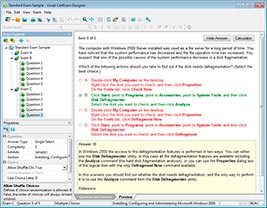
Use VCE Exam Simulator to open VCE files
HOW TO OPEN VCEX FILES
Use ProfExam Simulator to open VCEX files
ProfExam at a 20% markdown
You have the opportunity to purchase ProfExam at a 20% reduced price
Get Now!