Download VMware vSphere Foundation 5.2 Administrator.2V0-12.24.CertDumps.2026-04-09.20q.tqb
| Vendor: | VMware |
| Exam Code: | 2V0-12.24 |
| Exam Name: | VMware vSphere Foundation 5.2 Administrator |
| Date: | Apr 09, 2026 |
| File Size: | 236 KB |
How to open TQB files?
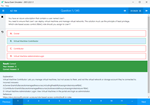
Files with TQB (Taurus Question Bank) extension can be opened by Taurus Exam Studio.
Purchase
Coupon: TAURUSSIM_20OFF
Discount: 20%
Demo Questions
Question 1
While deploying a new VMware Cloud Foundation environment, a cloud administrator validates the information entered into the Deployment Parameter Workbook. The validation action results in an error and the VMware Cloud Builder GUI error message does not identify the cause.
Which logfile can the administrator use to identify the cause of the validation error?
- VMware SDDC Manager appliance - vcf-deployment-debug.log
- VMware Cloud Builder appliance - vcf-bringup-debug.log
- VMware SDDC Manager appliance - vcf-bringup-debug.log
- VMware Cloud Builder appliance - vcf-deployment-debug.log
Correct answer: D
Explanation:
The vcf-deployment-debug.log file on the VMware Cloud Builder appliance contains detailed logs related to the deployment process, including any validation errors. This log will help identify the cause of the error during the deployment validation phase. The vcf-deployment-debug.log file on the VMware Cloud Builder appliance contains detailed logs related to the deployment process, including any validation errors. This log will help identify the cause of the error during the deployment validation phase.
Question 2
Which two SDDC Manager operations can be executed on an NSX Edge cluster after it has been deployed? (Choose two.)
- Redeploy
- |Sync
- Expand
- Delete
- Shrink
Correct answer: B, D
Explanation:
After an NSX Edge cluster has been deployed, you can perform a sync operation to ensure the NSX Edge cluster is in sync with the configuration in SDDC Manager.Deleting an NSX Edge cluster can be done after it has been deployed if it is no longer required or needs to be removed from the environment. After an NSX Edge cluster has been deployed, you can perform a sync operation to ensure the NSX Edge cluster is in sync with the configuration in SDDC Manager.
Deleting an NSX Edge cluster can be done after it has been deployed if it is no longer required or needs to be removed from the environment.
Question 3
An administrator needs to configure and manage storage resources and policies to optimize performance of a VCF environment configured with vSAN.
What two steps should the administrator take? (Choose two.)
- Enable vSphere HA to ensure high availability and resource distribution.
- Monitor the vSAN performance service for insights into the performance issues.
- Analyze the current vSAN storage policies and adjust them as needed.
- Disable vSAN health alerts to reduce administrative overhead.
- Decrease the number of disk groups per host to improve performance.
Correct answer: B, C
Explanation:
The vSAN performance service provides valuable insights into the storage performance, helping identify potential bottlenecks or areas for improvement.Analyzing and adjusting vSAN storage policies is crucial for ensuring optimal performance. Policies such as RAID levels, storage encryption, and other settings can be tweaked to better match the environment's performance requirements. The vSAN performance service provides valuable insights into the storage performance, helping identify potential bottlenecks or areas for improvement.
Analyzing and adjusting vSAN storage policies is crucial for ensuring optimal performance. Policies such as RAID levels, storage encryption, and other settings can be tweaked to better match the environment's performance requirements.
Question 4
An administrator has a requirement to share the contents of a Content Library across multiple vCenter instances.
What steps should the administrator perform to meet this requirement?
- Create a Subscribed content library on a single vCenter instance and perform a synchronization
- Create a Subscribed content library on each vCenter instance and enable publishing
- Create a Local content library on each vCenter instance and perform a synchronization
- Create a Local content library on a single vCenter instance and enable publishing
Correct answer: D
Explanation:
To share the contents of a Content Library across multiple vCenter instances, you need to create a Local content library on one vCenter instance and enable publishing. This allows the library to be accessible by other vCenter instances, where they can subscribe to it, ensuring the content is shared. To share the contents of a Content Library across multiple vCenter instances, you need to create a Local content library on one vCenter instance and enable publishing. This allows the library to be accessible by other vCenter instances, where they can subscribe to it, ensuring the content is shared.
Question 5
An organization has experienced performance issues and requires a detailed analysis of infrastructure performance, capacity, utilization, and compliance using VMware Aria components.
What three steps should be followed to generate and analyze these reports? (Choose three.)
- Create custom dashboards to monitor performance metrics
- Use Aria Operations for Logs to correlate log data with performance
- Access Aria Operations and navigate to the Reports section
- Export the reports for further analysis and compliance verification
- Run predefined reports on capacity and utilization
Correct answer: A, B, E
Explanation:
Creating custom dashboards in Aria Operations allows administrators to visualize and monitor performance metrics specific to the organization's needs, making it easier to analyze the infrastructure.Using Aria Operations for Logs helps correlate log data with performance issues, enabling a deeper analysis and understanding of the root causes of performance problems.Running predefined reports on capacity and utilization provides valuable insights into how resources are being consumed, helping identify areas that need optimization or adjustment. Creating custom dashboards in Aria Operations allows administrators to visualize and monitor performance metrics specific to the organization's needs, making it easier to analyze the infrastructure.
Using Aria Operations for Logs helps correlate log data with performance issues, enabling a deeper analysis and understanding of the root causes of performance problems.
Running predefined reports on capacity and utilization provides valuable insights into how resources are being consumed, helping identify areas that need optimization or adjustment.
Question 6
A Cloud Administrator has been tasked with verifying all of the prerequisites are in place prior to deploying VMware Aria Suite Lifecycle. The following information has been provided for the Aria Suite Lifecycle implementation:
hostname: lcm
domain: vcf.company.com
IP address: 10.0.0.150/24
IP gateway: 10.0.0.1
Which two items must the Cloud Administrator ensure are available prior to deploying VMware Aria Suite Lifecycle? (Choose two.)
- An Application Virtual Network is configured in SDDC Manager
- A DNS PTR Record for 10.0.0.1 that points to lcm.vcf.company.com
- A DNS A Record for lcm.vcf.company.com that points to 10.0.0.150
- An allocated IP address for the NSX standalone Tier-1 Gateway
- A CA-signed SSL certificate for Aria Suite Lifecycle added to SDDC Manager
Correct answer: C, D
Explanation:
A DNS A record is necessary to resolve the hostname (lcm.vcf.company.com) to the specified IP address (10.0.0.150) so that it can be correctly accessed during the deployment.A DNS PTR record is required for reverse DNS lookup, which ensures proper identification of the IP address (10.0.0.1) to the hostname (lcm.vcf.company.com), which is important for network validation during the deployment process. A DNS A record is necessary to resolve the hostname (lcm.vcf.company.com) to the specified IP address (10.0.0.150) so that it can be correctly accessed during the deployment.
A DNS PTR record is required for reverse DNS lookup, which ensures proper identification of the IP address (10.0.0.1) to the hostname (lcm.vcf.company.com), which is important for network validation during the deployment process.
Question 7
An administrator needs to configure an ESXi host and create a host profile to ensure consistent configuration across multiple hosts in a cluster.
Which three steps are necessary to achieve this? (Choose three.)
- Configure the desired settings on a reference ESXi host.
- Extract the host profile from the configured reference host.
- Manually configure each host to match the reference host settings.
- Remediate the non-compliant hosts to ensure they match the host profile.
- Apply the host profile to all hosts in the cluster.
Correct answer: A, B, D
Explanation:
First, configure the desired settings on a reference ESXi host. This host will be used as the template for creating a consistent configuration across the cluster.After configuring the reference host, extract the host profile from it. This captures the configuration of the reference host as a host profile.Remediation is necessary to ensure that other hosts in the cluster align with the reference host's configuration. The host profile can be applied, and remediation will correct any non-compliant settings on other hosts. First, configure the desired settings on a reference ESXi host. This host will be used as the template for creating a consistent configuration across the cluster.
After configuring the reference host, extract the host profile from it. This captures the configuration of the reference host as a host profile.
Remediation is necessary to ensure that other hosts in the cluster align with the reference host's configuration. The host profile can be applied, and remediation will correct any non-compliant settings on other hosts.
Question 8
An administrator is tasked with performing password rotation for VMware Cloud Foundation components managed by SDDC Manager.
Which action must be taken to complete this task?
- Use the Async Patch CLI Tool to rotate passwords for all components.
- Schedule a maintenance window to rotate the passwords to minimize disruption.
- Manually update the passwords in vCenter Server and NSX Manager.
- Access the SDDC Manager UI and navigate to the password management section.
Correct answer: D
Explanation:
Password rotation for VMware Cloud Foundation components is managed via the SDDC Manager UI. In the password management section of the SDDC Manager, administrators can rotate the passwords for various components like vCenter Server, NSX Manager, and other management components. Password rotation for VMware Cloud Foundation components is managed via the SDDC Manager UI. In the password management section of the SDDC Manager, administrators can rotate the passwords for various components like vCenter Server, NSX Manager, and other management components.
Question 9
When commissioning new hosts in VMware Cloud Foundation, which three parameters must be provided? (Choose three.)
- Network Pool Name
- Storage Type
- Hardware Type
- SSO Domain Name
- ESXi Version
- Username
Correct answer: B, D, F
Explanation:
Storage Type: The storage type needs to be specified during the commissioning of new hosts in VMware Cloud Foundation, as it is important for the configuration of storage resources for the hosts.SSO Domain Name: The Single Sign-On (SSO) domain is an essential parameter to associate the hosts with the existing authentication domain.Username: The administrator needs to provide a username with appropriate permissions to configure the hosts during the commissioning process. Storage Type: The storage type needs to be specified during the commissioning of new hosts in VMware Cloud Foundation, as it is important for the configuration of storage resources for the hosts.
SSO Domain Name: The Single Sign-On (SSO) domain is an essential parameter to associate the hosts with the existing authentication domain.
Username: The administrator needs to provide a username with appropriate permissions to configure the hosts during the commissioning process.
Question 10
An administrator needs to create a custom role in vCenter Server that is part of VMware Cloud Foundation environment to grant specific privileges to a group of users.
Which two actions should be taken to create this custom role? (Choose two.)
- Choose the privileges required for the custom role.
- Navigate to the Roles section in the vSphere Client.
- Apply the custom role to the root of the vCenter Server inventor/.
- Assign permissions to the custom role before adding privileges.
- Clone an existing role in SDDC Manager to create the custom role.
Correct answer: A, B
Explanation:
When creating a custom role, it is essential to choose the appropriate privileges that the role will require. These privileges define what actions the users in the role can perform.To create and manage roles, you need to navigate to the "Roles" section in the vSphere Client. This is where roles are defined and assigned within the vCenter Server. When creating a custom role, it is essential to choose the appropriate privileges that the role will require. These privileges define what actions the users in the role can perform.
To create and manage roles, you need to navigate to the "Roles" section in the vSphere Client. This is where roles are defined and assigned within the vCenter Server.
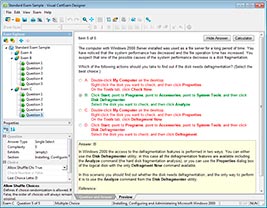
HOW TO OPEN VCE FILES
Use VCE Exam Simulator to open VCE files
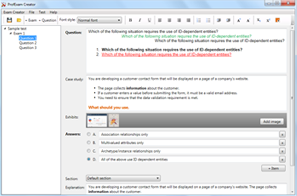
HOW TO OPEN VCEX FILES
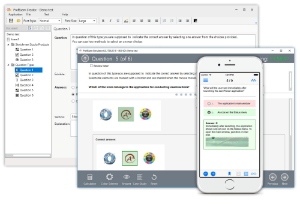
Use ProfExam Simulator to open VCEX files
ProfExam at a 20% markdown
You have the opportunity to purchase ProfExam at a 20% reduced price
Get Now!